
Barber County
KSGenWeb

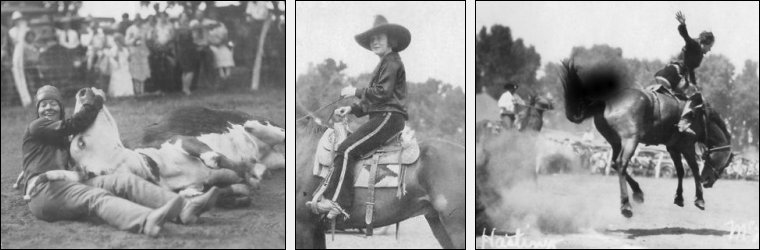
Three photographs of Fox Hastings at McLain's
Roundup near Sun
City, Kansas.
Photos by Homer
Venters, courtesy of his great-nephew, Mike
Venters.
Photos © Mike Venters 2005. Used with his permission.
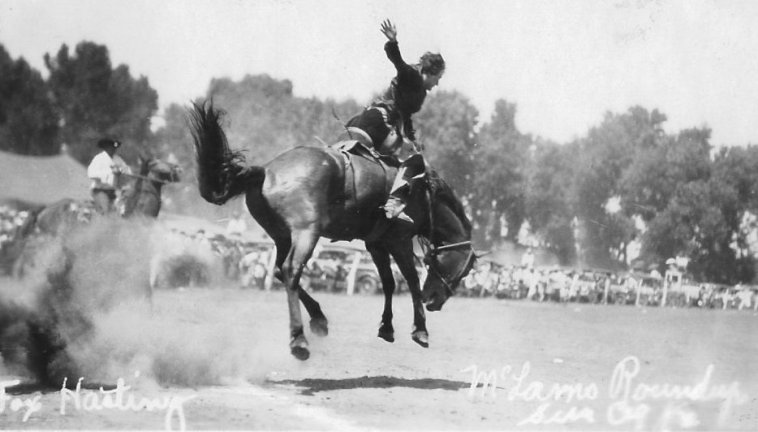
Fox Hastings, famous cowgirl, rides a bucking bronc, McLain
Roundup, Sun City, Barber County, Kansas.
Photo by Homer
Venters, courtesy of his great-nephew, Mike
Venters.
Photo © Mike Venters 2005. Used with his permission.
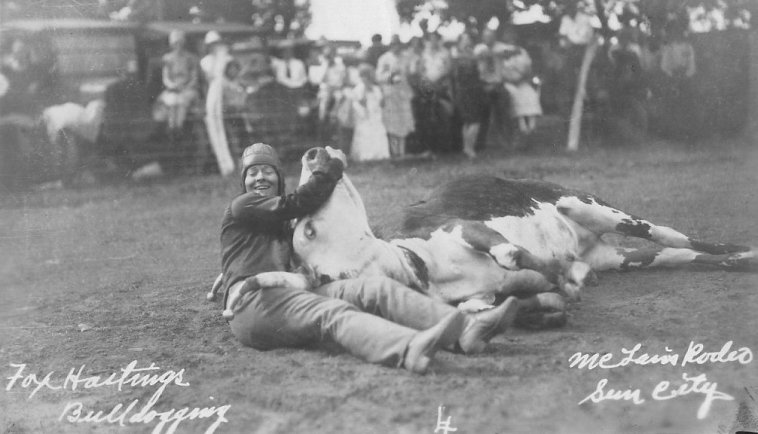
Fox Hastings, first woman bulldogger in professional rodeo, at
McLain Roundup, Sun City, Barber County, Kansas.
Photo by Homer
Venters, courtesy of his great-nephew, Mike
Venters.
Photo © Mike Venters 2005. Used with his permission.
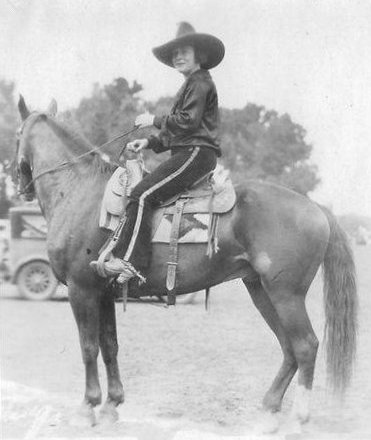
Fox Hastings at McLain's Roundup, Sun City, Barber County,
Kansas.
Photo by Homer
Venters, from the collection of Brenda McLain.
Chronology of the Life of Fox Hastings
and some of her contemporaries1891 Mike Hastings, who is a primary focus of the collection, was born Paul Raymond (Mike) Hastings in Cheyenne, Wyoming on October 23, 1891. At 11, he ran away from home and found work breaking wild horses. He entered his first rodeo in 1910 at Laramie, Wyoming. -- Estelle Gilbert Papers, Box 1, Folder ##, Dickinson Research Center, National Cowboy & Western Heritage Museum, Oklahoma City, Oklahoma.
1898 Eloise Fox Wilson was born in Galt, California, to Wesley Galveston Fox, born in Galveston, Texas, and Susie Agusta (Sawyer) Fox, who was born in Galt, California. Informant: Bill Twain Clemens of Florence, Arizona. -- Death certificate for Eloise Fox Wilson of Winslow, Navajo County, Arizona. Arizona State Department of Health, Division of Vital Statistics, State File No. 4441, Registrar's No. 1619.
1899 21 November 1899 - Charlie C. Wilson, who would be the second husband of Eloise Fox Hastings, was born in Kansas to Mr. & Mrs. Willis Wilson. (Willis Wilson was born in Virginia.) -- Death certificate for Charlie C. Wilson of Winslow, Navajo County, Arizona. Arizona State Department of Health, Division of Vital Statistics, State File No. 4556, Registrar's No. 6_(?).
1912 - 1914 Fox Hastings ran away from home to marry Mike Hastings.
Age 14 - "Born Eloise Fox, she ran away from her California home at the age of 14 to begin her career riding bucking horses and trick riding. Joining Irwin Brother's Wild West Show she rode on one of the fastest running trick riding horses performing at that time." --
Age 16 - Mike Hastings was married to Eloise Fox Hastings, who ran away from convent school at 16 to join a Wild West show. After she met up with Hastings, he taught her to ride and rodeo, and in 1924 she became the first woman steer wrestler. Later they were divorced. -- Estelle Gilbert Papers
1916 In August 1916, Guy Weadick produced the New York Stampede at Sheepshead Bay Speedway in Brooklyn. It ran for 12 days. Bill Pickett's bulldogging was the main attraction. Other great rodeo performers such as Hoot Gibson, Leonard Stroud, Chester Byers, Mike Hastings, Cowgirls Lucille Mullhall, Fox Hastings, Florence La Due (Weadick's wife), and Frances Irwin were there. -- Black Cowboy Bill Pickett Gained Fame Throughout West, by Tom Bean.
1917 In 1917, when the late Duke of Windsor (then Prince of Wales) was a boy, he and the Royal Family attended a rodeo performance at Saskatoon, Saskatchewan in which Hastings was participating. During a backstage visit, Mike Hastings put the young Prince on a horse and led him around the corrals. -- Estelle Gilbert Papers
1923 Fox Hastings was photographed at McLain's Roundup near Sun City, Kansas, by Homer Venters. McLain's Roundup was an annual event held by Marion Francis McLain, usually known as Frank McLain. It was often called McLain's Rodeo or the Sun City Rodeo.
1924 In 1924, when Mike Hastings was participating in the first international rodeo in London, the Prince of Wales presented Hastings with a thoroughbred horse in appreciation of the thrill he had had riding a real American cowboy horse (in 1917). -- Estelle Gilbert Papers
1924 The RODEO (movie) - Events and personalities at the British Empire Exhibition rodeo at Wembley Stadium. Rl. 1. Shot of Tex Austin (43-54); some of the cowgirls taking part in the World Championship contest (113-133); Mabel Strickland (136-143); Bonnie McCarrol (147-153); Donnie Glover (158-164); Fox Hastings (176-184); Helen Elliot (187-193); Ruth Wheat (195-201); Florence Hughes (204-210); Donna Glover (213-217); Bea Kirnan (220-225). The arena, cowgirls and cowboys riding in and around in a parade (292). The judges enter on horseback - Tom B. Hickman. G.M. Jones, Phil Yoder and Tex Austin (305-369). The cowgirls bronco riding - Florence Hughes (400-419); Ruth Wheat is thrown and carried off (426-462); Mabel Strickland riding in slow motion (467-483); Fox Hastings mounts and rides (489-530). Cowboys bareback bronco riding - first rider (536-551); Frank Studenick is thrown (555-579); the next rider shot from above is thrown (596); more riders (634); a rider in slow motion (638-659). Trick and fancy roping - first competitor (662-675); Chester Beyers using two ropes (681-694); Tommy Kirnan roping his wife and pony (701-722); he then does it standing on his head (727-737). Rl. 2. Calf roping - the calf is let out (749753); when it crosses the line the rider ropes it (759-795); more competitors roping calves (803-922). Cowboys bronco riding - various competitors (925-1087). Steer wrestling - competitors ride alongside the steer and jump on to it and throw it flat on its side (1115-1243). Wild horse race, the competitors saddle and mount the horses in the arena (1254-1309). (1310ft). --
1924 Fox Hastings was one of the first and only female bulldoggers in rodeo history. Her fastest time was 17 seconds, a record she set in 1924. - --
1924 Her (Fox Hastings') cowgirl career began in 1924 with a bulldogging exhibition at the Houston Stock Show. Hastings went on to ride rough stock and was known to remark before she sprinted out of a chute: "If I can just get my fanny out of the saddle and my feet planted, there’s not a steer that can last against me." Foghorn Clancy, a flamboyant rodeo announcer and publicity man, made her the most photographed and interviewed cowgirl of the late twenties. But Clancy didn’t do it all. Fox was very good at her event. She established a record time of seventeen seconds in 1924. She was a charismatic performer, who could smile at the camera while lying in the mud, still clinging to the neck of a freshly thrown steer. -- Cowgirl Art by Sharon K. Hunt.
1924 After marrying fellow rodeo star Mike Hastings, Eloise Fox dropped her first name, becoming Fox Hastings. She made her bulldogging debut at a 1924 rodeo in Houston, receiving help and encouragement from her husband, himself a highly successful bulldogger. --
1925 See photographs of Fox Hastings as took part in the 1925 Tucson, Arizona, Rodeo Parade and the Rodeo at Santa Catalina (Kramer) Field.
1925 - 1927 "A Mike and Fox Hastings scrapbook covering 1925-1927, photographs of early rodeo performers including a Mabel Strickland photograph inscribed to Fox Hastings, and a reminiscence of Fox Hastings by Reba Perry Blakely are also included." -- Estelle Gilbert Papers
1926 Frontier Days Ladies' Bronco Contest. Frontier Days Cowgirl entrants, approx. 1926. Left to Right: Bea Kirman, Fort Worth; Rose Smith, El Paso; Mabel Strickland, Walla Walla; Fox Hastings, Pendleton; Ruth Roach; Fort Worth; Florence Hughes, San Antonio. Photo by Ralph Doubleday. The original caption for the photo indicates that all were expected to compete for "King Kalakauna's spurs -- the prize of all broncdom at the Frontier Days celebration to open at Cheyenne, Wyo. on July 22nd." -- Frontier Days, Wyoming Tales and Trails: Lulu Bell Parr, Mabel Strickland, Fox Hastings, Ruth Roach, Brian Roach
1928 At the Ellensburg, Wash. rodeo in 1928 Reba Perry Blakely encountered some of the world Champion Cowgirls, such as Vera McGinnis, Vedal Tindel, Rene Shelton, Mabel Strickland, Tad Lucas and Fox Hastings. Working with these outstanding Cowgirls was a complete thrill for the young horsewoman. -- Cowboy Hall of Fame comes to Modoc County, Modoc Record, May 22, 1997.
1929 The approximate year that both Charlie C. Wilson and Eloise Fox Wilson began living in Arizona according to their death certificates. It is reasonable to assume that they married around this time. -- Death certificate for Eloise Fox Wilson of Winslow, Navajo County, Arizona; Arizona State Department of Health, Division of Vital Statistics, State File No. 4441, Registrar's No. 1619. Death certificate for Charlie C. Wilson of Winslow, Navajo County, Arizona; Arizona State Department of Health, Division of Vital Statistics, State File No. 4556, Registrar's No. 6_(?).
1940s In the forties, Fox developed tuberculosis, an illness not uncommon among rodeo and livestock professionals of those times. Her second husband Chuck was by her side through several agonizing years of treatment, but the joy of learning that the disease was in remission was short-lived. On August 2, 1948 (sic), Chuck Wilson died of a heart attack. -- Cowgirl Art by Sharon K. Hunt. (According to his death certificate, Charles C. Wilson died on July 30, 1948.)
1945 Based on the length of residence in the Winslow area given in Charlie C. Wilson's death certificate, Charlie and Eloise Fox Wilson moved to Winslow, Arizona, in about May of 1945. -- Death certificate for Charlie C. Wilson of Winslow, Navajo County, Arizona; Arizona State Department of Health, Division of Vital Statistics, State File No. 4556, Registrar's No. 6_(?).
1948 Charlie C. "Chuck" Wilson died of a heart attack. ABSTRACT of Death Certificate: Place of Death: 709 W. Elm, Winslow, Navajo County, Arizona. Length of stay in community: 2 years, 7 months. Length of stay in Arizona: 19 years. Full name: Charlie C. Wilson. He was not a veteran. Sex: Male. Race: White. Wife: Eloise Fox. Birthdate: November 21, 1899. Age: 48 years, 8 months, 9 days. Birthplace: Kansas. Usual occupation: Manager of a cattle ranch. Father's name: Willis Wilson, born in Virginia. Mother's name and birthplace: unknown. Informant: G. (?) Sullivan of Winslow, Arizona. His remains were removed to Phoenix, Arizona. Funeral director: Scott & McMillan of Winslow, Arizona. Death Registrar: Mrs. Ed. J. Cahill, 7-31-1948. Date of death: July 30, 1948. Time of death: 9:30 p.m. Cause of death: Coronary occlusion. Signature: M.g. Wright (?) of Winslow, Arizona, 7-31-1948. -- Death certificate for Charlie C. Wilson of Winslow, Navajo County, Arizona. Arizona State Department of Health, Division of Vital Statistics, State File No. 4556, Registrar's No. 6_(?).
1948 8-14-1948 - Eloise (Fox) Hastings Wilson committed suicide. ABSTRACT of Death Certificate: Place of Death: Adams Hotel, Phoenix, Maricopa County, Arizona. Length of stay in community: 2 weeks; length of stay in Arizona: 19 years. Full name: Eloise Fox Wilson. She was not a veteran. Sex: Female. Race: White. Marital status: Widowed. Birthdate: 1898. Age: 50 years. Birthplace: Galt, California. Usual occupation: Housewife. Industry or business: Home. Father's name: Wesley Galveston Fox, born in Galveston, Texas. Mother's name: Susie Agusta Sawyer, born in Galt, California. Informant: Bill Twain Clemens of Florence, Arizona. Her remains were cremated at Greenwood, Phoenix, Arizona, on 8-16-1948. Funeral director: A.L. Moore and Sons, 333 W. Adams, Phoenix, Arizona. Death Registrar: Mrs. Cort (?) I. Hughes. Date of death: August 14, 1948. Time of death: about 3:00 a.m. Immediate cause of death: "Investigation by police and myself shows bullet wounds in abdomen and head and indicate that wounds were self-inflicted. According to note found with the body, it was apparently with suicidal intent." Cause of death: Suicide. Date of occurence: August 14, 1948. Signature: Illegible, Ex-Officio Coroner, East Phoenix Pret., 8-16-1848. -- Death certificate for Eloise Fox Wilson of Winslow, Navajo County, Arizona. Arizona State Department of Health, Division of Vital Statistics, State File No. 4441, Registrar's No. 1619.
1948 8-16-1948 - The remains of Eloise (Fox) Hastings Wilson were cremated at Greenwood, Phoenix, Arizona, on 8-16-1948. Funeral director: A.L. Moore and Sons, 333 W. Adams, Phoenix, Arizona. -- Death certificate for Eloise Fox Wilson of Winslow, Navajo County, Arizona. Arizona State Department of Health, Division of Vital Statistics, State File No. 4441, Registrar's No. 1619.
1965 Paul Raymond (Mike) Hastings, first husband of Eloise Fox, died. -- Estelle Gilbert Papers
1974 Mike Hastings was inducted into the Rodeo Hall of Fame. -- Estelle Gilbert Papers
1976 Reminiscence of Fox Hastings written by fellow rodeo cowgirl Reba Perry Blakely. -- Estelle Gilbert Papers
1979 Reba Perry Blakely was inducted into the Cowgirl Hall of Fame in 1979 as a Western Heritage Honoree. Their narration of her was, "Reba became an accomplished trick roper, rider and pony express contestant. She was a World Champion Woman's Relay Rider as well. Reba drew on her knowledge to become a recognized researcher and author of western and rodeo history. Her articles have appeared in dozens of magazines and newspapers while she has spent over 50 years documenting the coming of the pioneer and the horse to the west." -- Cowboy Hall of Fame comes to Modoc County, Modoc Record, May 22, 1997.
1987 Fox Hastings, 1882 (sic) - 1948, was inducted into the Cowboy Hall of Fame and is recorded as being from Texas. Her inclusion is based on her being a Steer Wrestler and Saddle Bronc Rider and Rodeo Trick Rider -- Cowboy Hall of Fame.
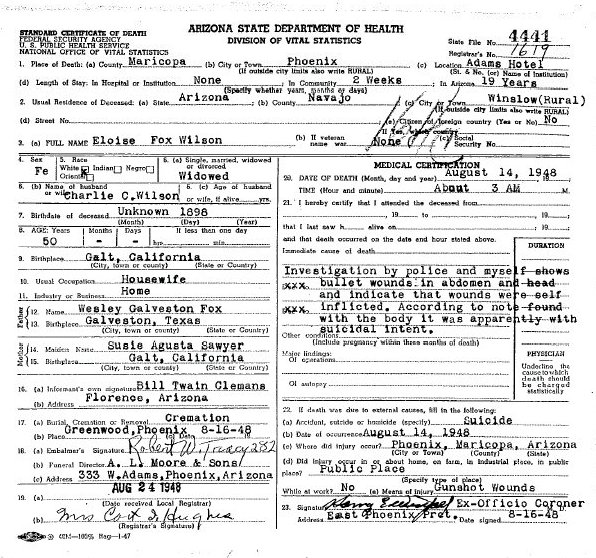
Death certificate for Eloise Fox Wilson of Winslow, Navajo
County, Arizona
Arizona State Department of Health, Division of Vital Statistics, State File No. 4441, Registrar's No. 1619.ABSTRACT: Place of Death: Adams Hotel, Phoenix, Maricopa County, Arizona. Length of stay in community: 2 weeks; length of stay in Arizona: 19 years. Full name: Eloise Fox Wilson. She was not a veteran. Sex: Female. Race: White. Marital status: Widowed. Birthdate: 1898. Age: 50 years. Birthplace: Galt, California. Usual occupation: Housewife. Industry or business: Home. Father's name: Wesley Galveston Fox, born in Galveston, Texas. Mother's name: Susie Agusta Sawyer, born in Galt, California. Informant: Bill Twain Clemens of Florence, Arizona. Her remains were cremated at Greenwood, Phoenix, Arizona, on 8-16-1948. Funeral director: A.L. Moore and Sons, 333 W. Adams, Phoenix, Arizona. Death Registrar: Mrs. Cort (?) I. Hughes. Date of death: August 14, 1948. Time of death: about 3:00 a.m. Immediate cause of death: "Investigation by police and myself shows bullet wounds in abdomen and head and indicate that wounds were self-inflicted. According to note found with the body, it was apparently with suicidal intent." Cause of death: Suicide. Date of occurence: August 14, 1948. Signature: Illegible, Ex-Officio Coroner, East Phoenix Pret., 8-16-1848.
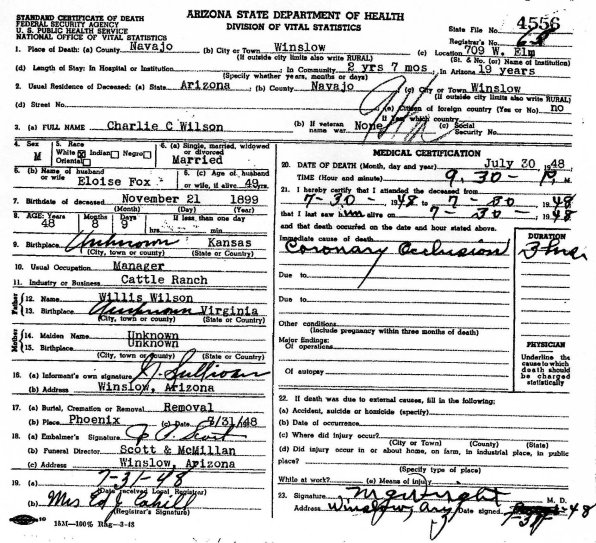
Death certificate for Charlie C. Wilson of Winslow, Navajo
County, Arizona
Arizona State Department of Health, Division of Vital Statistics, State File No. 4556, Registrar's No. 6_(?).ABSTRACT: Place of Death: 709 W. Elm, Winslow, Navajo County, Arizona. Length of stay in community: 2 years, 7 months. Length of stay in Arizona: 19 years. Full name: Charlie C. Wilson. He was not a veteran. Sex: Male. Race: White. Married. Wife: Eloise Fox. Birthdate: November 21, 1899. Age: 48 years, 8 months, 9 days. Birthplace: Kansas. Usual occupation: Manager of a cattle ranch. Father's name: Willis Wilson, born in Virginia. Mother's name and birthplace: unknown. Informant: G. (?) Sullivan of Winslow, Arizona. His remains were removed to Phoenix, Arizona. Funeral director: Scott & McMillan of Winslow, Arizona. Death Registrar: Mrs. Ed. J. Cahill, 7-31-1948. Date of death: July 30, 1948. Time of death: 9:30 p.m. Cause of death: Coronary occlusion. Signature: M.g. Wright (?) of Winslow, Arizona, 7-31-1948.
Also see:
"Homer Venters: Vintage Rodeo Photographer", The Western Horseman, July 1972.
Marion Francis McLain was the founder of the McLain Roundup rodeo in Sun City.
McLain's Round-Up, Sun City, Kansas, July 8-9-10:
Big Barber Co. Attraction Announces Entry of World Famous Performers.
Barber County Index, June 25, 1938.McLain's Roundup: The Memories of Joe Massey Photos by Homer Venters, captioned by Joe Massey, from the collection of Brenda McLain, courtesy of Kim Fowles.
McLain Roundup photos by Homer Venters
From the collection of Brenda McLain, courtesy of Kim Fowles.McLain's Annual Roundup, Sun City, Kansas. Photograph by Murphy
Courtesy of Nathan Lee and William Lee.Sometimes, though, the end of the McLain's Roundup rodeo wasn't the end of the excitement for local people, such as when Alva Trummel of Comanche County was kidnapped by Bonnie and Clyde while he was headed home from the "Sun City Rodeo":
Alva Trummel Kidnapped By Bandits, The Western Star, September 8, 1933.
The following off-site links will open in a new browser window:
Carl Studer Rodeo Scrapbook & Ephemera Center -- FF2/D01 Oversized Posters: McLain's 5th Annual Roundup: The Roundup ca. 1930.
Willard H. Porter Rodeo Collection -- Kansas, Medicine Lodge, 6th Annual McLain's Round Up, 1927 [1]
Following is the article which is quoted most often on the net, or
reproduced in full, usually without credit to the original web page.
===========
Fox Hastings was one of
the first and only female bulldoggers in rodeo history. Her fastest time
was 17 seconds, a record she set in 1924.
Born Eloise Fox, she
ran away from her California home at the age of 14 to begin her career
riding bucking horses and trick riding. Joining Irwin Brother's Wild
West Show she rode on one of the fastest running trick riding horses
performing at that time.
After marrying fellow rodeo star Mike
Hastings, Eloise Fox dropped her first name, becoming Fox Hastings. She
made her bulldogging debut at a 1924 rodeo in Houston, receiving help
and encouragement from her husband, himself a highly successful
bulldogger.
"To
the rodeo crowd she is Fox Hastings, cowgirl extraordinary. To
neighbors, she is Mrs. Mike Hastings, a good cook and tidy housekeeper."
Cowgirls, Savage p.73, quoting Newspaper Story.
Her career was marked
by injuries and spectacular performances, as this account illustrates:
"Notable among the special attractions was Fox Hastings who, though she
had suffered a broken rib the day before the show opened, bulldogged her
steer each of the three days of the rodeo proper. She had a contract to
fulfill and she couldn't let the management down..."
Sadly, in 1948, Fox
Hastings took her life in a Phoenix, Arizona hotel. But she is still
remembered today as one of the pioneer ladies of the rodeo.
http://www.cowgirls.com/dream/cowgals/hastings.htm
==============
http://www.nationalcowboymuseum.org/research/r_a_gilb.html
GUIDE to the
ESTELLE GILBERT PAPERS, 1923-2003
ESTELLE GILBERT (1912-2003). Papers,
1923-2003.
0.6
cubic feet (1 document box, 1 oversized folder).
Location: 0174; Flat File 2/Drawer 1.
Introduction:
Papers and photographs
of Estelle Gilbert, a horsewoman, rodeo performer, and longtime friend
of Rodeo Hall of Fame steer wrestler Mike Hastings. The collection
features more than 40 letters written to Gilbert by Hastings over a
period of 18 years and almost 20 photographs of New York rodeos and
rodeo performers in the late 1940s and early 1950s. A Mike and Fox
Hastings scrapbook covering 1925-1927, photographs of early rodeo
performers including a Mabel Strickland photograph inscribed to Fox
Hastings, and a reminiscence of Fox Hastings by Reba Perry Blakely are
also included.
Biography:
Estelle Gilbert was
born December 8, 1912 in Ansonia, Connecticut, but moved to Great Neck,
Long Island when she was four years old. As a child she learned to ride
horses and always had a great love for animals. After graduating from
high school, she moved to New York City where she took a position as a
secretary for an insurance company. In 1939, Gilbert bought a horse,
which she boarded at Cimarron Ranch, a dude ranch near Peekskill, New
York. She enjoyed life at the dude ranch, and in 1940 accepted an office
position at the ranch, which allowed her to spend more time riding. Work
as a trail ride escort and riding instructor soon followed. She became
acquainted with Mike Hastings, a former rodeo performer who was foreman
of the ranch.
She also worked for a time at Gene Autry’s
Flying A Ranch near Ardmore, Oklahoma, a job she got through Hastings
who had worked as a stock contractor for Autry. Under the tutelage of
Hastings, she was able to expand her riding abilities to include barrel
racing and trick riding, and she was eventually able to rodeo
competitively in these events in the late 1940s and early 1950s. During
this period she became a dude ranch commuter, spending summers at the
Cimarron Ranch in New York and winters at the Desert Willow Ranch near
Tucson, Arizona.
In the late 1950s, when she was too old to
rodeo and commute, she settled down near the Cimarron Ranch on her own
“two-horse ranch.” She was friend and companion to Mike Hastings until
his death in 1965. She continued to live in the Peekskill, New York
area, most often working as a waitress, until 1979, when she moved to
California. She eventually settled in Yucaipa, where she became active
in civic affairs, including the local animal shelter. She died at the
age of 90 on August 17, 2003.
Mike Hastings, who is
a primary focus of the collection, was born Paul Raymond (Mike) Hastings
in Cheyenne, Wyoming on October 23, 1891. At 11, he ran away from home
and found work breaking wild horses. He entered his first rodeo in 1910
at Laramie, Wyoming. He was an old school rodeo performer who was
willing to take a crack at just about any rodeo event, but steer
wrestling was his claim to fame. It is said that African American rodeo
cowboy Bill Pickett, who introduced the bulldogging or steer wrestling
event to rodeo, taught Mike his technique, which included biting the
lower lip of the steer after throwing it to keep it down. He was also
the owner of Stranger, one of the greatest bulldogging horses ever.
In 1917, when the late
Duke of Windsor (then Prince of Wales) was a boy, he and the Royal
Family attended a rodeo performance at Saskatoon, Saskatchewan in which
Hastings was participating. During a backstage visit, Mike put the young
Prince on a horse and led him around the corrals. In 1924, when Mike was
participating in the first international rodeo in London, the Prince
presented Hastings with a thoroughbred horse in appreciation of the
thrill he had had riding a real American cowboy horse.
Mike Hastings was
married to Eloise Fox Hastings, who ran away from convent school at 16
to join a Wild West show. After she met up with Hastings, he taught her
to ride and rodeo, and in 1924 she became the first woman steer
wrestler. Later they were divorced.
Between 1928 and 1936
Hastings was the stock boss for rodeo impresario Colonel W. T. Johnson.
In 1939, after he returned from working rodeo in South America, he took
a ride up to the Cimarron Ranch dude ranch near Peekskill, New York; he
fell in love with the place and was at Cimarron until the end of his
life in 1965. He was responsible for the ranch livestock and staged
weekend rodeo performances for the guests.
His only two extended
absences from Cimarron were at the request of Gene Autry. In 1941 he
purchased the stock that served as the nucleus of Autry’s new Flying A
Ranch Rodeo, and in 1942 Autry brought Hastings out to help on his ranch
near Ardmore, Oklahoma, which he did until Autry entered the United
States Air Force in 1943.
In addition to his
work on the Cimarron Ranch and his friendship with Estelle Gilbert,
Hastings also found time to mentor Peekskill local Harry Tompkins, who
would go on to be one of the top bull riders in the world. Mike died in
1965, and Estelle Gilbert scattered his ashes on the Texas property
owned by the children of Col. W. T. Johnson, which had been his request.
In 1974, Mike Hastings was inducted into the Rodeo Hall of Fame.
Sources
LeCompte, Mary Lou. Cowgirls of the Rodeo.
Urbana, Ill.: University of Illinois Press, 1993.
Porter, Willard H. Who’s Who in Rodeo.
Oklahoma City: Powder River Book Company, 1982.
Scope and Content:
The collection is
arranged into three series, Correspondence, Subject Files, and
Photographs.
Correspondence (1940-2001) series is comprised
primarily of more than 40 letters written by Mike Hastings to Estelle
Gilbert between 1940 and 1958. These letters by the rough-hewn and
unlettered Hastings document his life on the Cimarron Ranch and working
for Gene Autry, the lives and loves of his friends and associates,
injuries and illnesses, and his evolving relationship with Gilbert.
Hastings relates incidents such as a horse theft by a gang of teenagers
and the shipment of some saddles to Autry’s Oklahoma ranch, which were
eaten by insect larvae before they could be unpacked. Mentioned in the
correspondence is rodeo promoter Frank Moore, Cimarron Ranch owners Vern
and Lu Walters, and Vern’s brother C. J. Walters, who also owned a dude
ranch in the area. Also included in the correspondence are two typed
Cimarron Ranch daily schedules and a mid-1950s brochure for New York
dude ranches.
Other correspondence includes some letters to
Gilbert from the National Cowboy Hall of Fame concerning the donation of
items belonging to Mike Hastings, correspondence with friend and rodeo
performer Harry Tompkins, and a 1952 letter from author and illustrator
Paul Laune that discusses his wife’s problems with alcohol and mentions
photographer Charles Eggert’s trip out west to photograph in the
National Parks.
Subject Files (1925-2003) series includes
newspaper and magazine clippings about Gilbert, Hastings, and other
rodeo friends; a legal document concerning a 1945 Florida land purchase;
some items related to rodeo, including photocopies of one of Gilbert’s
Gene Autry’s Flying A Ranch Rodeo pay stubs and the original 1936 Rodeo
Cowboy Turtles Association petition; and some short writings by Gilbert.
Collection highlights include a nicely-done Mike and Fox Hastings
scrapbook covering 1925-1927 that includes the usual newspaper
clippings, but also some more unusual items such as a 1926 subpoena for
Mike Hastings to testify in a criminal trial of rodeo clown Red Sublett
in Tucson, Arizona. There is also a 1976 reminiscence of Fox Hastings
written by fellow rodeo cowgirl Reba Perry Blakely.
Photographs (1923-ca.
1960) series primarily documents Gilbert’s rodeo career and her
friendship with Hastings and others associated with the Cimarron Ranch,
but also includes some earlier rodeo performers known by Mike and Fox
Hastings. Included are four panoramic group photographs of the
performers from the 1946, 1947, 1951, and 1952 World’s Championship
Rodeos at Madison Square Garden, which include Gilbert; group
photographs featuring Gilbert, Hastings, Jasbo Fulkerson, Sally Rand,
Roy Rogers, Vern and Lu Walters, and others; backstage photographs from
the 1951, 1952, and 1953 Madison Square Garden rodeos; photographs, some
autographed, of Tex Austin, Eddie Burgess, Ruth Roach, Mabel Strickland,
and other early rodeo personalities; and several late-1940s photographs
of performers from Gene Autry’s Flying A Ranch Rodeo, including Estelle
Gilbert and Gene Autry. Also included is a short 16mm color film of
Gilbert riding at Cimarron Ranch dating from the early 1940s.
Subject Terms
Personal Names:
Autry, Gene, 1907-
Eggert, Charles
Fulkerson, Jasbo, 1904-1949
Gilbert, Estelle, 1912-2003
Hastings, Fox, 1882-1948
Hastings, Mike, 1891-1965
Johnson, W. T.
Laune, Paul
Moore, Frank
Rand, Sally, 1904-1979
Rogers, Roy, 1911-
Strickland, Mabel DeLong, 1897-1976
Sublett, Red, 1894-1950
Tompkins, Harry, 1927-
Corporate Names:
Cimarron Ranch (Peekskill, N. Y.)
Gene Autry’s Flying A Ranch Rodeo
Subject Headings:
Cowboys—New York
Cowgirls—New York
Dude ranches—New York
Rodeo honorees
Rodeo performers—New York
Rodeo performers—Wyoming
Rodeos—New York—New
York
Steer
wrestling
Processing Note:
The collection was
donated in two parts: by Estelle Gilbert in 1993 and by Jerry Cape of
Yucaipa, California in April 2004. Jonathan Nelson processed the
collection in May 2004. Seven rodeo programs were separated to the Rodeo
Program Collection and five items of rodeo memorabilia were separated to
the museum’s rodeo collection.
Ownership and Literary
Rights:
The Estelle Gilbert Papers is the property of
the Donald C. & Elizabeth M. Dickinson Research Center, National Cowboy
& Western Heritage Museum. Literary right, including copyright, belongs
to the National Cowboy & Western Heritage Museum, with the exception of
copyrighted artwork images and published literary works, which are the
property of the respective copyright holders. It is the responsibility
of the researcher, and his/her publisher, to obtain publishing
permission from individuals pictured, relevant copyright holders, and
the National Cowboy & Western Heritage Museum.
Restrictions on
Access:
The collection is open for research. It is
advisable for researchers to discuss their proposed research with staff
prior to visiting the Center.
Preferred Citation:
Estelle Gilbert
Papers, Box 1, Folder ##, Dickinson Research Center, National Cowboy &
Western Heritage Museum, Oklahoma City, Oklahoma.
=================
http://www.nationalcowboymuseum.org/research/r_a_rode.html
GUIDE to the
COLLECTION OF RODEO PROGRAMS AND EPHEMERA,
1905-2004
DICKINSON RESEARCH CENTER. Rodeo programs and ephemera, 1905-2004.
21.5 cubic feet (42 document boxes, 1 flat
box).
Location:
0351-0365.
Introduction:
The Collection of
Rodeo Programs and Ephemera includes more than 1,500 souvenir programs,
daily programs, brochures, prize lists, rules and other ephemera from a
wide variety of rodeos throughout the United States and several foreign
countries.
History:
Over the years the National Cowboy & Western
Heritage Museum accessioned many donated rodeo programs, brochures and
related ephemera from the Museum affiliated Rodeo Historical Society and
other sources. This material had been kept as a vertical file
collection, but to increase researcher access the decision was made to
improve the arrangement and create a finding aid.
Scope and Content:
The collection has
been arranged in two series, United States and Foreign.
United States <r_a_rode_series1a.html>
(1905-2004) comprises the bulk of the collection. The programs in this
series document rodeos in 40 states and from every decade of the 20th
century and into the 21st century. While the vast majority of the
programs are original, a small number of the earliest programs are
photocopies. Among the rodeos with the strongest coverage are La Fiesta
de los Vaqueros, Tucson, Arizona; Pikes Peak or Bust Rodeo, Colorado
Springs, Colorado; National Western Stock Show, Denver, Colorado; War
Bonnet Round-Up, Idaho Falls, Idaho; World’s Championship Rodeo, Boston,
Massachusetts; World’s Championship Rodeo, New York, New York; National
Finals Rodeo, Oklahoma City, Oklahoma; Pendleton Round-Up, Pendleton,
Oregon; Southwestern Exposition and Fat Stock Show, Fort Worth, Texas;
and Cheyenne Frontier Days, Cheyenne, Wyoming.
Highlights of the collection include extensive
documentation of the 1939 World’s Championship Rodeo at Madison Square
Garden, including typed daily event and contestant lists with
handwritten notes and livestock lists from the rodeo; a complete media
package from the 1959 National Finals Rodeo held in Dallas, Texas;
almost 40 years of Cheyenne Frontier Days programs dating from 1905 to
1996, including a deluxe 1931 program with a fold-out panoramic
photograph of the performers and grandstand; 17 different daily programs
and the souvenir program from the 1930 World Series Rodeo in New York
City; and all souvenir programs and many daily programs from the
National Finals Rodeos held in Oklahoma City, Oklahoma between 1965 and
1984.
In
addition to documenting rodeos, the programs also document the
professional activities of a wide variety of rodeo cowboys and cowgirls.
The rodeo performers who appear in the programs are virtually a who’s
who of 20th century professional rodeo including cowboys Larry Mahan,
Slim Pickens, Jim Shoulders and Leonard Stroud and cowgirls Marie
Gibson, Fox Hastings, Tad Lucas and Vera McGinnis along with many
others. The collection also documents the activities of local and
regional rodeo performers who competed in small town rodeos throughout
the United States. Some daily programs have contest results noted.
Additionally, the programs highlight a variety of musical, film and
television performers such as Roy Rogers, Dale Evans, Lorne Greene,
Clayton Moore, Liberace and others who appeared at some large venue
rodeos. “Gunsmoke” stars Ken Curtis and Milburn Stone autographed the
1965 San Angelo Fat Stock Show & Rodeo program. Named Native American
performance groups and rodeo specialty acts also appear in a number of
programs.
The
programs provide many examples of early 20th century small town
advertising. Programs from larger venues include many instances of rodeo
and cowboy themed advertisements.
Foreign <r_a_rode_series1b_2.html> (1924-1971)
includes rodeo programs from Australia, Canada, Cuba, England, France,
Germany, and Mexico. Highlights include 13 different daily programs from
the First International Rodeo, held in London in 1924 and the souvenir
program and nine different daily programs from Tex Austin’s World’s
Championship Rodeo, held in London in 1934.
=================
http://www.wyomingtalesandtrails.com/frontierdays4c.html
Frontier Days
Continued from
Previous Page.
From Wyoming Tales and Trails
This Page, Frontier Days continued; Lulu Bell
Parr; Mabel Strickland; Fox Hastings; Ruth Roach; Brian Roach.
Note that Lorena
Tricky's arm is in a cast. She participated in multiple events on the
circuit, winning two Roman Races, but was most famous for her technique
in relay races where she would literally transfer from the back of one
to the back of the other. One time she caught her pants on the
saddlehorn ripping them wide open. Her first entry was in San Francisco,
and she later entered in Cheyenne, Pendleton and Madison Square Garden.
At Cheyenne she was the winner of the 1920, 1921, 1924, and 1925 Ladies'
Relay. Additionally, she won the 1921 Ladies Saddle Bronc contest. In
one Ladies' Relay she entered with a broken leg with the cast removed
before the race. She accepted the trophy while on crutches. In one
saddle bronc contest she entered with a dislocated shoulder. Other
injuries sustained over the years included a skull fracture, a broken
jaw, and dislocated ribs. In 1927, she was acquitted of murdering her
abusive boy friend. Later she served a a stunt double for Mary Pickford.
Her McAlpin Trophy awarded by a New York hotel for winning the World
Championship Cowgirls Relay race is on display in the National Cowboy
and Western Heritage Museum.
Other cowgirls suffered injuries. Tad Lucas,
winner of the 1930 and 1931 Ladies' Relay, had her right forearm crushed
in the 1933 Chicago Show when her horse stepped on her arm and kicked
her. By 1935, she was again on the circuit. The following year in 1936,
her horse stepped on her back, but by the end of the year she was again
riding.
Ruth Roach, Photo by Ralph Doubleday.
Ruth Roach, winner of
the 1919 Women's Saddle Bronc contest, had her left leg crushed at
Madison Square Garden in 1933. A year later she was again thrown from
her horse and broke her wrist. Alice Greenough crushed her ankle at El
Paso and was on crutches for two years. At Madrid, Spain, she was thrown
and was in a coma for four days. Later in Australia, she received
injuries to both knees when a horse fell on her. Bonnie McCarrol, winner
of the 1922 Frontier Days Ladies' Saddle Bronc contest, was killed at
Pendleton in 1929. She was riding "hobbled." When thrown, she became
caught up in her gear and was trampled to death. Riding "hobbled" is
with the stirrups tied under the horse. Riding "slick" is with the
stirrups hanging loose. Women riders customarily rode hobbled. Men rode
slick.
Brian Roach of Chickasha, Oklahoma, was the
winner of the 1919 Calgary stampede Bronc riding contest and the 1919
Fort Worth Steer Riding Contest, and also was a performer with the
Miller Bros. 101. There he met and married Ruth Scantlin. Ruth Roach
became one of the leading cowgirl rodeo stars and won the 1920 Frontier
Days Ladies' Bronco Contest.
Frontier Days Cowgirl entrants, approx. 1926.
Left to Right: Bea Kirman, Fort Worth; Rose Smith, El Paso; Mabel
Strickland, Walla Walla; Fox Hastings, Pendleton; Ruth Roach; Fort
Worth; Florence Hughes, San Antonio. Photo by Ralph Doubleday
The original caption for the photo indicates
that all were expected to compete for "King Kalakauna's spurs -- the
prize of all broncdom at the Frontier Days celebration to open at
Cheyenne, Wyo. on July 22nd."
Although Ruth Roach and Brian Roach divorced,
she continued for the remainder of her career under the name of Ruth
Roach. Mrs. Roach was also noted for her sense of humor and for being
somewhat bosomy. In one contest she caught her blouse and bra on the
saddlehorn, ripping both wide open. As the rodeo officials rushed
forward to protect her modesty, she commented: "I sure do thank you
boys. I thought before I got off that bronc I was gonna black both my
eyes." Mrs. Roach died on her ranch in Texas in 1986.
Rose Smith was the wife of Oklahoma Curly
Roberts. Florence Hughes was a trick rider weighing only 90 pounds. Two
other cowgirls in the photo, Mabel Strickland and Fox Hastings, were a
part of husband and wife teams closely associated with Frontier Days.
Mabel DeLong Strickland (1897-1976) was married to 1916 and 1920 Saddle
Bronc Champion, Hugh Strickland. Mabel started entering rodeos while
still in high school at age 16 in Walla Walla. There she won the 1913,
1914, and 1915 Trick Riding Contest. She married Hugh in 1918. In
Cheyenne she won the 1922 and 1923 Ladies' Relay Championship and the
1923 Ladies' Saddle Bronc contest. in 1925 she roped and tied a steer in
24 seconds. The following year she appeared on the Frontier Days Program
cover riding Mike Hastings' horse "Stranger."
In 1941, Hugh
Strickland died. Mabel subsequently remarried to Sam Woodward. The Mabel
Strickland Woodward Museum in Cheyenne is named in her honor.
The dates shown on the photo are not in error.
Although Frontier Days is now conducted in the last full week of July,
in its early years the Rodeo was held in August. Lulu Bell Parr
(1876-1955) was an alumna of many of the early wild west shows. In 1903
she joined Pawnee Bill's. In 1908 she joined Col. Frederick T. Cummins'
Famous Indian Congress and Wild West performing at Brighton and appeared
before Edward VII. She later rejoined Pawnee Bill. By 1911, she had
joined the Miller Bros. 101 and was included within their Argentinian
tour in 1913. Even in the dying days of wild west shows she continued to
perform with the King Brothers as late as 1929 at age 53. In 1937,
facing poverty, Parr moved in with her brother and sister-in-law in
their tarpaper shack in Dayton, Ohio. There she remained surrounded by
mementos of better years until her death of a stroke in 1955.
Eloise Fox Hastings was married to Paul
Raymond "Mike" Hastings (1891-1965), a bulldogger and steer wrestler.
For discussion and photos of Mike Hastings, see subsequent pages. Fox
Hastings ran away from a convent at age 16 and joined the Irwin Bros.
Wild West show. She learned bulldogging from Mike. The two later
divorced. She remarried. In 1948, her husband died of a heart attack.
Two weeks later she committed suicide in her hotel room in Phoenix,
Arizona.
===================
http://www.rodeoattitude.com/dir_hd/gail/index.htm
BEHIND THE CHUTES AND
ELSEWHERE COWGIRLS DON’T JUST HAPPEN
THEY EARN THE TITLE
Most girls, born on ranches, were put atop a
horse when they were still in diapers by a dad or grandpa. Some stayed
on a horse for the rest of their lives and were fortunate enough to know
the true meaning of a cowgirl. But not all cowgirls began that way. Some
young-uns cut their teeth on silver spoons, or in the middle of a major
city, never knowing a thing about a horse, like how soft his upper lip
is when it nuzzles up against your arm, or how the trusty steed will
stand there when you fall off and wait for you to get back on.
It’s not their fault,
those city girls, that they didn’t start out with ‘country smarts’. But
some of them became the best cowgirls that were ever made. Back in the
beginning of rodeo and wild west there were women who bulldogged steers,
rode broncs, trick rode and roped, rode race horses or Roman rode with a
foot on each horse, but had started out in a much different world. The
story of Claire Belcher Thompson is that kind of a story.
Claire, whose real
name was Gladys Rogers Emmons, was born in Mansfield , Massachusetts ,
on February 4th, 1902 , to Florence and Henry Emmons. In 1907 her mother
divorced Emmons and brought Gladys to her grandmother, Frances Rogers
Harding, and left her.
Grandma Harding, and her aunt, Mabel Barnes,
lived in Mansfield , and raised Gladys to be a proper young woman. She
studied piano at the Conservatory of Boston and attended LaSalle Junior
College for one year. Her aunt also introduced her to horses and riding
in a proper way, including dressage.
Gladys married at eighteen, a young man by the
name of Sumner Barton Kirby, and the following year, 1921, they had a
daughter, Miriam Frances, who died ten days later of meningitis. The
sudden death of her daughter saddened Gladys and soon her marriage fell
apart.
She met
a rodeo performer named Bob Belcher, whose expertise was as a
bulldogger. Her background with horses and the handsome cowboy gave her
a new direction. Bob taught her to bulldog steers. By 1925 they were
working on the 101 Wild West Show. She changed her name to Claire and
was listed in their program as Claire Belcher, a lady bulldogger. She
also rode broncs, did some trick riding and was ready to try anything.
It is stated by a Kansas City newspaper that Claire and Bob Belcher led
the grand entry of the 101 Wild West Show there in 1925. By 1929,
however, she and Bob were divorced.
Although the media was sparse in her day
Claire got plenty of publicity. Her varied abilities and outgoing
personality caused her to be the subject of many articles. Her name
could be found often in the Billboard, an early day vaudevillian
periodical, that had a column for rodeo and wild west performers, called
The Corral; True West Magazine; Hoofs & Horns, just to name a few.
She married
Jack ‘Red’ Thompson who was a trick roper, who won many contests, as
well as a bulldogger. The two traveled the ‘rodeo road’ from New York to
Tucson to Cheyenne to Fort Worth to Kansas City , Chicago , Madison
Square Garden and London , England . Claire was often feted against Fox
Hastings, another cowgirl bulldogger, at various rodeos. She also won
the lady bronc riding at London in the Tex Austin rodeo there, 1934.
This versatile couple was well known in rodeo circles, and their names
often appeared in the win columns of rodeo results. They had a wonderful
life and the young woman raised in the east, knowing nothing about the
western way of life had taken to the life of a cowgirl with ease. In
fact in many interviews she would tell the reporter she was born in
Uvalde , Texas , on a ranch. It is surmised she thought her eastern
upbringing didn’t seem quite natural for a cowgirl of her abilities.
At the Burwell,
Nebraska , rodeo in 1936 Red Thompson was gored by a steer and was never
able to compete again. Although he lived until 1950 his condition
deteriorated over the years. Claire spent much time caring for him. She
tried to continue competing in rodeos and hoped they could live off her
earnings, but when that was not enough she put on weekend rodeos, with
Richard Akerman, at the Bar C Ranch, near Fort Worth , to help raise
money for Red’s medical expenses. Many of their rodeo friends helped,
including Mitzi Riley and her mother, Tad Lucas, who was a good friend.
Claire did many things to make money. She wrote a column for Hoofs &
Horns magazine called “Cowgirl Comments”, and later she was a columnist
for “Powder Puff & Spurs” a women’s rodeo magazine. She also assisted
the Marine Corp in their recruitment for World War II.
She moved to Lake City
, Florida , in 1960 after Red Thompson died. She married Frank S. Lohre
in 1963. Claire knew Frank from her 101 Wild West days as he had been in
the management end of the business. Claire (Gladys Rogers Emmons) Lohre
died on April 11, 1971 , in Lake City , Florida , and is buried in the
Spring Brook Cemetery in Mansfield , Massachusetts . She was, a true
cowgirl that earned her title.
Claire’s descendants are working very hard to
gather as much information about this early day cowgirl as possible. She
did not keep in touch with her family during the latter part of her life
and they would like to put the pieces of her life together. If you have
any knowledge of her please contact me by e-mail @ rodeogal@airmail.net
<mailto:rodeogal@airmail.net>, and I will put you in touch with her
family.
http://www.rodeoattitude.com/dir_hd/gail/index.htm
===================
http://72.14.209.104/search?q=cache:dh3mJx5PoKMJ:www.cowgirlart.net/foxbio.doc+%22Fox+Hastings%22+%2Brodeo&hl=en&ct=clnk&cd=50&gl=us
Cowgirl Art by Sharon K. Hunt
*FOX HASTINGS*
© Sharon Kay Hunt, 2003
3rd from right
Eloise Fox Hastings,
born Eloise Fox, ran away from a convent school in California at the age
of 16 to marry rodeo cowboy Mike Hastings. She dropped her first name
and became Fox Hastings. She joined the Irwin Brothers Wild West Show
and performed trick and bronc riding on one of the fastest running trick
riding horses of the time.
Her cowgirl career began in 1924 with a
bulldogging exhibition at the Houston Stock Show. Hastings went on to
ride rough stock and was known to remark before she sprinted out of a
chute: “If I can just get my fanny out of the saddle and my feet
planted, there’s not a steer that can last against me.”
Foghorn Clancy, a flamboyant rodeo announcer
and publicity man, made her the most photographed and interviewed
cowgirl of the late twenties. But Clancy didn’t do it all. Fox was very
good at her event. She established a record time of seventeen seconds in
1924. She was a charismatic performer, who could smile at the camera
while lying in the mud, still clinging to the neck of a freshly thrown
steer.
Fox was
a flashy dresser while performing trick and bronc riding. She sported
bold colors and enormous bows in her red hair. When she was bulldogging,
however, the attire was quite a contrast. It copied cowboy steer
wrestlers, and included boots laced to the knees, knickers, turtleneck
sweaters, and sometimes football helmets instead of hair ribbons.
Although the press was
traditionally respectful of cowgirl athletes, Hastings masculine attire
and participation in a rough, traditionally male event caused the press
to stress her domestic side. The following is an example: “To the rodeo
crowd she is Fox Hastings, cowgirl extraordinary. To neighbors she is
Mrs. Mike Hastings, good cook and tidy housekeeper.” The stress of rodeo
life, however, ended that marriage.
In the forties, Fox developed tuberculosis, an
illness not uncommon among rodeo and livestock professionals of those
times. Her second husband Chuck was by her side through several
agonizing years of treatment, but the joy of learning that the disease
was in remission was short-lived. On August 2, 1948, Chuck Wilson died
of a heart attack. Two weeks later at the Adams Hotel in Phoenix,
Arizona, the fifty-year-old cowgirl died of self-inflicted gunshot
wounds to the head and stomach. She left the following note to her
employer: "I didn’t want to live without my husband."
Eloise Fox Hastings
Wilson was inducted into the National Cowboy Hall of Fame, Oklahoma
City, Oklahoma in 1987.
The photograph used for this drawing of Fox
was taken in 1930 at the Houston, Texas show.
____________________
Original Photographs from the Collection of
the National Cowgirl Museum and Hall of Fame, Fort Worth, TX
Crandall, Judith Cowgirls Early Images and
Collectibles Schiffer Publishing, Ltd.
Flood, Elizabeth Clair Cowgirls Women of the
Wild West Zon Publishing Co.
Le Compte, Mary Lou Cowgirls of the Rodeo
University of Illinois Press
http://72.14.209.104/search?q=cache:dh3mJx5PoKMJ:www.cowgirlart.net/foxbio.doc+%22Fox+Hastings%22+%2Brodeo&hl=en&ct=clnk&cd=50&gl=us
=================
======================
LINK LIST:
http://www.rodeocountry.org/catherinedevinerodeo.htm Rodeo’s Renegade
Roses, a poem by Catherine Lilbit Devine: "Henderson, Riley, Hastings &
Creed / To the “Men Only” rule they all paid no heed / They broke
records & bones, faced derision & fear / Riding Broncs, Raising
families, they juggled home & career / Nasty wrecks were a given but
they seemed to bounce back..."
Catherine Lilbit
Devine
PO Box
837
Vail, AZ
85641
520-298-7639
520-548-3191
whisperswest@yahoo.com
==========
Rqst. permission to use photo, webmaster is
Jake Jacobson <tucariz@myexcel.com>
http://www.tucsonrodeoparade.com/Pages001/Album.htm Photographs from the
1925 Parade and the Rodeo at Santa Catalina (Kramer) Field Photo
caption: "Fox Hastings was one of the first and only female bulldoggers
in rodeo history. Her fastest time was 17 seconds, a record she set in
1924."
==========
https://id286.securedata.net/cowboysandimages.net//merchantmanager/view_information.php?pId=13
Cowboys and Images "Cowboys, cowgirls and events from Rodeo’s “Golden
Age”. A selection of custom prints, made one-at-a-time, ... Fox Hastings
11” x 14” Custom Art Print ..."
=================
SEARCH
http://search.ebay.com/Fox-Hastings_W0QQcatrefZC6QQfposZQ5AIPQ2fPostalQQfromZR10QQfsooZ2QQfsopZ2QQftrtZ1QQftrvZ1QQsacatZQ2d1QQsadisZ200QQsargnZQ2d1QQsaslcZ2QQsbrftogZ1QQsofocusZunknown
Fox Hastings Current e-bay search for items related to Fox Hastings.
http://www.rodeoattitude.com/dir_hd/gail/mable_03.htm Mabel Strickland
"The book, BOB CROSBY, WORLD CHAMPION COWBOY, written by his wife,
Thelma Crosby & Eve Ball, she wrote, “The parade through the streets of
Cheyenne was always a thrilling spectacle. That year ( 1925) it was led
by Mabel Strickland astride her beautiful white horse, carrying an
American flag. Behind her rode Nellie Tayloe Ross, Governor of Wyoming.”
In 1926 the cover of the Cheyenne Frontier Days program was a photograph
of Mabel Strickland riding a bronc named Stranger. The only woman to
ever be featured on the cover of the program.
Hugh Strickland
enjoyed pitting Mabel against male steer ropers, and finally they
encourage him to do contract exhibition steer roping. It was no secret
they were ‘tired’ of having Mabel as competition! She rode Buster,
Hugh’s roping horse, for her trick riding performances. She did
hippodrome stands, vaults, and even passed under the belly of the horse.
In 1922 Mabel
had won at many rodeos, - Cheyenne, Pendleton - to name a couple. By the
time they arrived at Madison Square Garden in the fall her arrival and
activities were covered by the press. She had won the important McAlpin
Trophy and invitations were many. Mrs. William P. Hamilton, chairman of
the Argonne Association, invited the rodeo participants to a dinner,
where she displayed Strickland’s trophy. A New York Herald reporter
wrote that Mabel, along with Bonnie McCarroll and Fox Hastings, all clad
beautifully in evening gowns, had “utterly ruined all Eastern ideas
concerning lady broncho busters.” - by Gail Woerner
http://books.google.com/books?id=pxCm62KCJ4kC&pg=PA76&lpg=PA76&dq=%22fox+hastings%22+rodeo&source=web&ots=zEF09SI5hp&sig=NDxJ87DtLbsG1R8AE2HiW4S2TuE&output=html
Cowgirls A page from the book by
http://econtent.unm.edu/cdm4/item_viewer.php?CISOROOT=/acpa&CISOPTR=1512&CISOBOX=1&REC=18
Photo caption: "Group of cowgirls from top left; Fox Hastings, Bea
Kirnan, Rose Smith and Mabel Strickland. Bottom row left to rights; Ruth
Roach and Florence Fenton ". (The Tex Austin Collection is comprised of
over 4,000 items including photographs, film and glass negatives and
ephemera on the subject of rodeos 1922 - 1935)
http://econtent.unm.edu/cdm4/item_viewer.php?CISOROOT=/acpa&CISOPTR=1512&CISOBOX=1&REC=18
http://www.cartermuseum.org/collections/smith/collection.php?asn=LC-S6-531&mcat=5
Cowboy Photographer: Edwin E. Smith Photo caption: "Texas rodeo
performer [Fox Hastings], 1920-1935. Gelatin dry plate negative."
http://www.wwfrontier.nu/poem.html Wild Women of the West Poem by
Danielle Fienhage AKA Cynthia Ann Parker.
http://www.cowgirls.com/dream/cowgals/hastings.htm Fox Hastings: A
Biography
http://www.cowgirls.com/ www.cowgirls.com/
http://item.express.ebay.com/Collectibles_Photographic-Images__1920s-Cowgirls-of-the-Cheyenne-Rodeo-Photo_W0QQitemZ6195960787QQihZ010QQddnZCollectiblesQQadnZPhotographicQ20ImagesQQcmdZExpressItem
1920s Cowgirls of the Cheyenne Rodeo Photo Photo for sale on ebay as of
4 April 2007.
http://cartermuseum.com/collections/smith/collection.php?asn=LC-S6-577&mcat=5
Cowboy Photographer: Erwin E. Smith Photo caption: "Rodeo Cowgirl
Contestants [Standing from left: Florence Hughes Randolph, Ruth Roach,
Mabel Strickland, Reine Hafley Shelton, Mildred Douglas, Bonnie
McCarroll, Rose Smith, Maud Tarr; squatting from left: Bea Kirnan, Mayme
Stroud, Fox Hastings], ca. 1925-1926. Gelatin dry plate negative."
http://books.google.com/books?id=pxCm62KCJ4kC&pg=PA70&lpg=PA69&ots=zEF0aSDZkj&dq=%22eloise+fox%22&output=html&sig=-PC5I2jRaTsC_03WVnHdtx-BhQ4
Composite photo of Fox Hastings, from Cowgirls By Candace Sherk Savage
==================
BIBLIOGRAPHY
-----------
http://www.amazon.com/Cowgirls-Rodeo-Pioneer-Professional-Athletes/dp/0252020294
http://www.amazon.com/Cowgirls-Rodeo-Pioneer-Professional-Athletes/dp/0252020294
Cowgirls of the Rodeo: Pioneer Professional Athletes
Cowgirls of the Rodeo: Pioneer Professional
Athletes (SPS) (Hardcover)
by Mary LeCompte (Author) "American rodeo owes
its very existence to the public's continuing fascination the cowboy
hero, and what the Pulitzer Prize-winning historian William H. Goetzmann
and art..."
----------------
http://www.amazon.com/Great-Books-About-Cowgirls/lm/3KL4HPJL2YEJB/ref=cm_lmt_dtpa_f_2_rdssss0/102-5630589-4473732?pf_rd_m=ATVPDKIKX0DER&pf_rd_s=listmania-center&pf_rd_r=1BMNPFCJ8Y3SE2NG2TVJ&pf_rd_t=201&pf_rd_p=253462201&pf_rd_i=0252020294
http://www.amazon.com/Great-Books-About-Cowgirls/lm/3KL4HPJL2YEJB/ref=cm_lmt_dtpa_f_2_rdssss0/102-5630589-4473732?pf_rd_m=ATVPDKIKX0DER&pf_rd_s=listmania-center&pf_rd_r=1BMNPFCJ8Y3SE2NG2TVJ&pf_rd_t=201&pf_rd_p=253462201&pf_rd_i=0252020294
Great Books About Cowgirls
Great Books About Cowgirls A Listmania! list
by Ellen Reid Smith (Austin, TX United States)
-------------
FILM
http://ftvdb.bfi.org.uk/sift/title/22381?view=synopsis
http://ftvdb.bfi.org.uk/sift/title/22381?view=synopsis The RODEO - NFA
Catalogue
Events and personalities at the British Empire
Exhibition rodeo at Wembley Stadium. Rl. 1. Shot of Tex Austin (43-54);
some of the cowgirls taking part in the World Championship contest
(113-133); Mabel Strickland (136-143); Bonnie McCarrol (147-153); Donnie
Glover (158-164); Fox Hastings (176-184); Helen Elliot (187-193); Ruth
Wheat (195-201); Florence Hughes (204-210); Donna Glover (213-217); Bea
Kirnan (220-225). The arena, cowgirls and cowboys riding in and around
in a parade (292). The judges enter on horseback - Tom B. Hickman. G.M.
Jones, Phil Yoder and Tex Austin (305-369). The cowgirls bronco riding -
Florence Hughes (400-419); Ruth Wheat is thrown and carried off
(426-462); Mabel Strickland riding in slow motion (467-483); Fox
Hastings mounts and rides (489-530). Cowboys bareback bronco riding -
first rider (536-551); Frank Studenick is thrown (555-579); the next
rider shot from above is thrown (596); more riders (634); a rider in
slow motion (638-659). Trick and fancy roping - first competitor
(662-675); Chester Beyers using two ropes (681-694); Tommy Kirnan roping
his wife and pony (701-722); he then does it standing on his head
(727-737). Rl. 2. Calf roping - the calf is let out (749753); when it
crosses the line the rider ropes it (759-795); more competitors roping
calves (803-922). Cowboys bronco riding - various competitors
(925-1087). Steer wrestling - competitors ride alongside the steer and
jump on to it and throw it flat on its side (1115-1243). Wild horse
race, the competitors saddle and mount the horses in the arena
(1254-1309). (1310ft).
http://ftvdb.bfi.org.uk/sift/title/22381
The RODEO
(1924)
Copyright date
Not available
Production start date
Not available
Production end date
Not available
Production
countries
Great
Britain
Notes
Not available
---------------------
http://www.modocrecord.com/97_ARCHIVES.html
Cowboy Hall of Fame comes to Modoc County
Tucked away in the high mountains of Modoc
County in North Eastern California a lady of rodeo resides in a rest
home. Reba Perry Blakely shares a room with her trunks of writings,
tapes, newspaper clippings, pictures, memorabilia and memories.
By 1930 Reba Perry had be come a World
Champion Re lay Rider. Small and petite she could fly like the wind on
race horses and she was in great demand by owners of some of the best
horses on the circuit. She was well known for her flat racing, relay
races and pony express expertise throughout Washington, Oregon and
western Canada.
At the Ellensburg, Wash. rodeo in 1928 Reba encountered some of the
world Cham pion Cowgirls, such as Vera McGinnis, Vedal Tindel, Rene
Shelton, Mabel Strickland, Tad Lucas and Fox Hastings. Working with
these outstanding Cowgirls was a complete thrill for the young
horsewoman.
Vera
McGinnis, trick rider and movie star from Hollywood, Calif. and Reba
soon became close friends even though Reba was fifteen years her junior.
Vera invited the little cowgirl from Washington to come to California
and she would teach here trick riding. Career until 1954.
A Rodeo Historian and Western Heritage
Researcher has been her goal in life to record the history of rodeo on
tape and typewriter.
Reba has been on assignment for many
newspapers and magazines in the West and has trunks of articles and
clippings to prove it. She is a recognized researcher, author, and
authority of early days of the West. Her historical articles are well
known through out the media.
Following the rodeo circuit led Reba to
Alturas, Modoc County, California where she was friends with another
rodeo great, the late Hippy Burmister. Traveling in her car with her
typewriter, tape recorder, trunks of clippings and letters and other
meager belongings she moved into a little cabin in 1990 in Alturas.
Reba Perry Blakely was inducted into the
Cowgirl Hall of Fame in 1979 as a Western Heritage Honoree. Their
narration of her was, "Reba became an accomplished trick roper, rider
and pony express contestant. She was a World Champion Woman's Relay
Rider as well. Reba drew on her knowledge to become a recognized
researcher and author of western and rodeo history. Her articles have
appeared in dozens of magazines and newspapers while she has spent over
50 years documenting the coming of the pioneer and the horse to the
west."
After
months of correspondence the decision was made to induct Reba Perry
Blakely into the Western Heritage di vision and the Rodeo Historical
Society of the Cowboy Hall of Fame.
The rodeo historian could not go to the Hall
of Fame in Oklahoma City, Okla. so the Hall of Fame came to Modoc, the
presentation must be made.
On April 30, 1997, Cecil Jones and his wife
Fran of the Rodeo Historical Society from the Rowell Ranch Rodeo from
Hayward, Calif. made the trip to Alturas to make the presentation. When
Cecil presented the honoree with her gold medal lion, plaque and
corsage, Reba was ecstatic and thrilled beyond her wildest dreams. Even
in her wheelchair with oxygen helping to fill her weak lungs she was
overjoyed.
=============================
http://www.truewestmagazine.com/cgi/Blah/Blah.pl?b-WOTW/m-1151952243/s-all/
exact copy of
http://www.cowgirls.com/dream/cowgals/hastings.htm
===============================
Dubious 1916 date for
Fox's performance
http://www.livestockweekly.com/papers/96/01/25/25bean.html
Black Cowboy Bill
Pickett
Gained
Fame Throughout West
By Tom Bean
Bill Pickett was born December 5, 1870, in
Travis County, Texas, about 30 miles northwest of Austin. He was the son
of Tom and Mary Pickett, former slaves who had been brought to Texas by
their owners, the Barton family of South Carolina. They came to Texas in
the 1850’s. Bill’s mother had Cherokee, white and Negro blood.
The fifth grade in one of the little country
schools in Travis County was as far as Bill got in the way of an
education. He was a bright, energetic youngster who was always ready to
run an errand for a few pennies or a nickel. Being raised on a farm
where there were livestock, Bill grew up without fear of horses or
cattle. When he saw a forty-pound bulldog holding a cow by sinking his
teeth in her upper lip, Bill decided that he could also do that.
He was about 15 years old when he came by
where some white cowboys were having a hard time holding some calves
during a branding. Bill told one of the cowboys that he could hold a
calf by himself. The cowboys didn't believe it. They planned to have
some fun out of Bill. One of them roped a calf, threw him, and told Bill
to tie on to him. Bill caught the calf’s upper lip with his teeth as he
had seen the bulldog do. The calf didn't bawl or move while the cowboys
applied the hot iron and completed their work on the calf.
Up to that time, the term "bull-dogging"
referred to getting cattle out of the brush by the use of dogs. Two dogs
were usually used, one a heel-dog to nip at the cow’s heels while the
other one caught and held her by the lip until a cowboy could come with
a rope and tie the cow to the nearest tree. When Bill held that first
calf for the white cowboys to brand, that was not only the beginning of
bulldogging as we know it today, it was also the only one of the several
rodeo events that can be attributed to one person, Bill Pickett.
And it was the beginning of the spectacular
career of one of the most popular and long-lasting rodeo performers in
the history of that sport.
Bill liked to work around stock. After he held
that calf like a bulldog, he became a much talked-about youngster around
the Austin cowpens. He and his four brothers rode their milkpen calves
and tried to get them to pitch, and roped them like all farm boys did.
This had to be done while "the old man" wasn’t looking. The Pickett boys
all dreamed of being cowboys and rodeo performers.
By the time he was sixteen, Bill began to put
bulldogging to work by helping get wild cattle out of the
brush on the ranches around Austin. He
developed the art of bulldogging from a horse, just as you see this act
performed in rodeos today.
Bill and four of his brothers rode broncs on
Sunday afternoons anywhere they could get a crowd together, and picked
up a little pocket change by "passing the hat." Bill’s first performance
as a professional bulldogger was in a wild west show in Nashville,
Tennessee, before a reunion of Confederate veterans. The old warriors
were amazed when they saw Bill catch a steer and bulldog him, using his
teeth to hold the steer.
December 2, 1890, Bill Pickett and Maggie
Turner were married in Taylor, Texas, by a Baptist minister. Bill and
Maggie became the parents of nine children, two boys who died in
infancy, and seven girls who all lived to maturity .
In the 1890's, Bill and four of his brothers,
Ben, J.J., C.H. and B.F. Pickett, organized "Pickett Brothers Bronc
Busters and Rough Riders Association." They advertised: "We break all
wild horses with much care. Good treatment to all animals. Perfect
satisfaction guaranteed. Catching and training wild cattle a specialty."
Bill had a dusky, copper-colored complexion.
When he
reached
manhood he weighed 145 pounds, was all muscle, stood five feet seven
inches tall, with thin legs, broad shoulders and strong arms.
Florence Reynolds, a cowgirl bronc rider, said
of Bill: "He was a great bulldogger and pickup man. I wouldn’t have
anyone else pick me off a bronc. He was a good, kind person. I visited
with him several times. Everybody liked Bill. He didn’t talk much."
Bill worked for a rancher named Lee Moore at
Round Rock, Texas. Moore was so impressed with Bill's way of bulldogging
that he became Bill's show manager, and entered him in shows in such
cowtowns in Texas as Fort Worth, Houston and San Antonio. Moore showed
Bill in Arizona and Colorado, also.
Dave McClure, a well known figure in rodeos,
and himself a performer, managed Bill in 1903 and 1904. He billed him as
"the most daring cowboy alive". A Denver Post article on Cheyenne
Frontier Days, said of Bill Pickett and Ira Wines, "For bronc busting
and steer throwing unequaled, they will give an exhibition at Cheyenne.
They are the best in the world at their specialties."
Guy Weadick, a Canadian cowboy and rodeo
performer, teamed up with Bill in 1905, as Bill's traveling companion
and manager. Zack Miller, one of the three famous Miller Brothers (Joe,
Zack and George) of the 101 Ranch and 101 Rodeo show, saw Bill and
Weadick perform at the Fort Worth Fat Stock and Rodeo in the spring of
1905.
Zack told
his brothers about Bill and Weadick, and the Miller Brothers booked Bill
for "The Greatest Wild West Show Ever," to take place in Guthrie, Indian
Territory (now Oklahoma), June 7, 8 and 9 of that year. This was the
beginning of Bill's long association with the Miller Brothers 101 Wild
West Show and the 101 ranch. Bill worked on the ranch as a cowboy when
he was not traveling with the show.
Bill's wife, Maggie, and their seven daughters
lived on the 101 Ranch part of the time, and part of the time they lived
in Ponca City, so that the girls could attend school. The Miller
Brothers Wild West Show was a big success, and Bill's bulldogging was
one of the main attractions. When the show appeared in Chicago in May
1907, there were 90 cowboys and cowgirls, 70 Indians, 300 head of
horses, cattle, and buffalo, and a number of covered wagons and
stagecoaches. After showing throughout the United States that year, the
101 Wild West Show went to Mexico for the winter.
Joe Miller bet one of the Mexican promoters
that Bill could stay in the ring with one of their fighting bulls for 15
minutes. Bill stayed 30 minutes, risking his life time and time again,
but for the first time, he failed to bulldog his bull. That was not part
of the bet. The bull's neck was so thick that Bill couldn't get his arms
around it.
Bill
went with the 101 Wild West Show to tour South America, showing in
Argentina and Brazil. The show then went to Europe, and was showing in
England when World War I broke out in August 1914. Under the British War
Act, the 101 livestock and any other thing that belonged to the show
that could be used in the British war effort was sequestered and paid
for. The show performers were left to get back home the best way they
could. The German submarines made ocean voyages extremely dangerous.
In August 1916, Guy Weadick produced the New
York Stampede at Sheepshead Bay Speedway in Brooklyn. It ran for 12
days. Bill's bulldogging was the main attraction. Other great rodeo
performers such as Hoot Gibson, Leonard Stroud, Chester Byers, Mike
Hastings, Cowgirls Lucille Mullhall, Fox Hastings, Florence La Due
(Weadick's wife), and Frances Irwin were there.
Will Rogers was performing at Ziegfield’s
Follies at the time. Will managed to see the daytime show of The
Stampede, and to visit a lot of his friends. Bill Pickett and Will
Rogers had been friends for a long time. They were both part Cherokee
Indian, and proud of it. Ex-President Theodore Roosevelt, a lover of
western sports, attended some of the performances.
The Miller Brothers re-activated the 101 Wild
West Show and opened in Oklahoma City April 21, 1925. It took 30
railroad cars to haul the performers, livestock, employees and
equipment. There were several other shows and circuses on the road, and
the 101 Wild West Show, for the first time, began to lose money.
Joe Miller died, mysteriously, in 1927. George
Miller was killed in a car wreck in 1929. The bottom fell out of
everything that year. In August 1931 the 101 Wild West Show concluded
its last performance. It closed down in Washington, D.C. Somehow, they
raked up enough money to ship everything back to the 101 Ranch. On
December 16, 1931, Fred C. Clark was appointed receiver for the bankrupt
101 Ranch and its properties.
On March 19, 1932, Bill Pickett was still
employed on the 101 Ranch, and was helping shape up a bunch of broncs
for a liquidation sale. There were about 150 broncs in the corral. Bill
roped one of them, and somehow got jerked up in the air and fell at the
heels of one of the broncs. The horse kicked Bill in the head. He was
rushed to the hospital in Ponca City. He never regained consciousness,
but lingered 14 days, and died April 2, 1932.
Clark, the bankruptcy receiver, paid for all
of Bill's funeral expenses. He said that Bill had worked for the 101
Ranch for most of his adult life, so he thought it was a proper expense
of the ranch.
Will Rogers had a national radio program at the time, and he announced
over the radio that Bill was to be buried on the 101 Ranch. Rogers also
announced that he and Bill were close friends, and that he had visited
Bill and his wife, Maggie, in their home many times.
Bill Pickett was the only black cowboy to ever
be elected to The Cherokee Strip Cowpunchers Association. In 1971, Bill
was elected to The National Rodeo Cowboy Hall of Fame which is
affiliated with the National Cowboy Hall of Fame in Oklahoma City, an
honor which he so rightly deserved.
===============================
Copyright © 1996 - The USGenWeb® Project, KSGenWeb, Barber County

This page was last updated
01/28/2026