

Barber County
KSGenWeb

Early History and Settlers of Barber County, Kansas
I would like to
thank Kansas Genealogy Society, Inc. for their contribution of this article to
the Barber County KSGenWeb. Barber County, Kansas is one of the southern tier of
counties bordering the state of Oklahoma located in the central part of the
state. It was organized in 1873, from territory originally embraced in
Washington County. The county was named for Thomas W. Barber (1. See story
below), who was killed near Lawrence [Kansas] on December 6, 1855. It was
intended, when the county was organized, that it should bear the name “Barber,”
but in some manner the spelling was changed to “Barbour” and stood that way
until 1883, when the legislature passed an act changing the name to “Barber,”
it’s present form, according to original intention. Its area is 1,134 square
miles. In the winter of 1871-72 the first white settler, a man named Griffin,
located a ranch on a branch of the Medicine Lodge river, about a mile from the
present site of Sun City, in the northwest part of the county. This pioneer was
killed in the Indian Territory the following summer, and C. H. Douglass is now
the leading merchant in the town.
The following spring E. H. Mosley, and two
men named Lockwood and Leonard, located on the Medicine Lodge river in the
southeastern part of the county near the present town of Kiowa. Mosley brought
with him goods for Indian trade and spent his time hunting buffalo and buying
hides for the eastern market, while the other men broke some prairie and engaged
in farming.
This displeased the Indians, who opposed white settlement in
this section. On July 30, 1872 they raided the homes of Leonard and Lockwood,
and in the fight that ensued Mosley was killed, but the other two men saved
themselves by remaining in the house inside a stockade. The Indians left after
killing most of the stock.
In October, 1872, Eli Smith joined this
settlement, and a store was opened there by G. Hegwer in the spring of 1873.
Derick Updegraff settled on land near the present site of Medicine Lodge in
December, 1872. Solmon P. Tuttle drove in a large herd of Texas cattle and
wintered them on the Medicine River, near this claim in the fall of 1872. During
the year claims were taken up in the vicinity of William Walter, W. E.
Hutchinson, Jake Ryan, A. L. Duncan, David Hubbard and John Beebe, while Samuel
Larsh and a man named Wyncoop took up claims on Cedar creek 3 miles from the
Updegraff ranch. The first graded cattle were brought into the county in the
spring of 1873 by William Carl, who held them on the river about 12 miles above
Medicine Lodge.
Lake City, on the upper Medicine Lodge River, was settled by
Reuben Lake about the same time. During the spring and summer of 1873 a number
of people came and the northern part of the county became settled. Ralph Duncan
was the first white child born in the county, in the spring of 1873, and the
first wedding took place in July, 1874, when Charles Tabor married a Miss Moore.
S. Miller and Mary Hale were married at Sun City at an early day, but the exact
date is unknown.
Indian depredations continued through the spring of 1874 and
Cutler’s History of Kansas (p. 1,521) says: “It was in the summer of 1874 that
the so-called Indian raid occurred - when a band of Indians, led by a number of
white men, it is alleged, came into this county and murdered several citizens up
the Medicine River.” For protection the citizens built stockades, one of which
was erected near the center of the present city of Medicine Lodge. It was made
of cedar posts set upright in the ground. Another stockade was built 12 miles up
the river at Sun City, and for further protection a company of militia was
formed to fight the Indians.
The first school district of the county, which
included Medicine Lodge was organized in the spring of 1873, and the school
building erected that year was used until 1882. Early religious services in the
county were held by traveling Methodist preachers, but no regular organization
was affected until 1878.
The first newspaper was the Barber County Mail,
which was started on May 20, 1879, by M. J. Cochran. It was sold the next year
to J. W. McNeal and E. W. Iliff, who at once changed the name and started the
Cresset.
County Organization
The first record of the county commissioners
is dated July 7, 1873. The board consisted of S. H. Ulmer, L. H. Bowlus and J.
C. Kilpatrick. On Sept. 1 the board made a contract with C. C. Bemis for a
courthouse to cost $25.000, and the clerk was directed to issue warrants for
that amount, but the building was never erected. On September 2, 1873, W. E.
Hutchinson was appointed immigration agent, and warrants to the amount of $1,000
were drawn in his favor. On October 6, G. W. Crane received the appointment as
advertising agent and was given $5,000, or as much of that amount as was needed
of that amount, to advertise the advantages of the county.
The county was
divided on November 7, 1973, into three districts for the election of
commissioners, and on February 11, 1874, a special election was held to
determine the question of issuing bonds to the amount of $40,000 for the
erection of a court-house. The result of the election was a majority of 41 votes
against the issue, but under a law of March 7, 1874, the county commissioners
issued the bonds.
The first regular election of county officers took place in
November, 1873. The vote of the Medicine Lodge district was thrown out for some
reason, and the officers chosen by the remainder of the county were, M. D. Hauk,
county clerk; Jacob Horn, county treasurer; D. E. Sheldon, probate judge; Reuben
Lake, sheriff; S. B. Douglas, superintendent of public instruction; C. H.
Douglas, clerk of the district court; M. S. Cobb, register of deeds; M. W.
Sutton, county attorney.
The records of the general election of 1874 are
missing. County officials have been elected as follows - County Clerks: S. J.
Shepler , 1875-77; R. A. Ward, 1879; J. E. Chapin, 1881. County Treasurers:
Jacob Horn, 1875; J. W. McNeal 1877; J. E. Chapin, 1879; C. T. Rigg, 1881.
Sheriffs: C. L. Walker, 1875; J. Moore, 1877; J. T. Taylor, 1879; C. T Rigg,
1881. Probate Judges: W. M. Friedly, 1876-78; S. J. Shepler, 1880-82. County
Superintendent of Public Instruction: C. C. Bond, 1875; M. L. Palmer, 1876; J.
W. Cornelius, 1878; T. S. Lindley, 1880; A. Axline, 1882. Clerks of the District
Court: W. G. Osborn, 1875; T. W. McClure, 1877; S. W. Lard, 1878; T. W. Osborne,
1879; Robert A. Talliaferro, 1880-82. Registers of Deeds: J. R. Easley, 1875;
Edward Ozbun, 1877; J. R. Easley, 1878; W. A. Mount, 1879; L. W. Moore, 1881.
County Attorneys: B. P Ayres, 1876-78; James T. Whitelaw, 1880; E. Sample, 1882.
Surveyors: P. Hartzel, 1875; George E. Wise, 1877; T. A. Bayley, 1879; A.
Bayley, 1879; A. Denton, 1880-81. Coroners: George Ebersal, 1875; J. V.
Fishburn, 1877; William Fitch, 1879; J. W. Singer, 1881.
Medicine Lodge
Medicine Lodge takes it’s name from the river that skirts the town site on the
west. This stream in turn was named by the Indians, who often met upon its banks
in council for “making medicine.” The location of the city is an admirable one,
Elm Creek lying on the east, and the Medicine River on the west, joining their
waters a quarter mile south of the city, while between them rises the lofty
plateau of the town site.
In October, 1872, William Walters had a temporary
camp at the fork below the present city but made no effort at settlement, and
moved away the following spring. In February, 1873, the party, led by John
Hutchinson came to Medicine Lodge, and laid out the town site of 400 acres. The
first building on the town site was the structure which now forms the dining
room of the Medicine Lodge House. It was put up by D. Updegraff and used then as
now, for hotel purposes Lumber was hauled from Hutchinson [Kansas], and Bemis,
Hutchinson & Company proceeded to put up an office - the building which now
forms the south wing of the Medicine Lodge House. This was followed by a large
general store erected by Bemis, Jordon & Company, on the spot now occupied by
Paynes’s Bank.
L. H. Ulmer was the next merchant to locate here, and was
followed in the summer of 1873 by D. E Sheldon. Immigration was rapid during
1873, that year witnessing the arrival of C. T. Rigg, the first physician in the
town, and now Sheriff of the county: W. E. Hutchinson, the first attorney, and
M. Sutton, also a disciple of Blackstone. The first blacksmith shop was put up
by Cicero Widner, and the first drug store opened by S. A. Winston during this
season. The Indian scare of 1874 checked settlement and caused a large exodus,
but the following years showed a steady growth that has made Medicine Lodge an
“eminently solid” city.
A post office was established at Medicine Lodge in
1873, and the mail handled by W. E. Hutchinson. S. A. Winston was postmaster in
1873, and was followed by M. D. Houck, D. E. Van Slyke, Eli Smith, and W. D. Van
Slyke, the present official. The first post office was in the Winston building,
now owned by Dr. C. T. Rigg, and leased as a billiard room. It was in this room
that the first term of court was held. Thence it was moved to the lot now
occupied by the Medicine Valley Bank, thence to the Friedly building, the little
frame north of Little’s store, and its present quarters on the west side of Main
street. It was made a money order office in 1879, and the first order purchased
by Charles Ellis, July 8, of that year.
On May 21, 1879, the order
incorporating Medicine Lodge as a city of the third class was signed, and the
first city election was set for June 7, 1879. This election resulted in the
choice of W. W. Cook, mayor; H. M. Davis, police judge; W. W. Standiford, J. N.
Iliff, George Mitts, J. Storey, and D. M. Carmichael, councilmen. S. J. Shepler
served a short time as city clerk, and followed by J. W. Upperman. A. W. Little
was mayor in 1880, J. E. Chapin in1881, and S. J. Shepler in 1882. Police Judges
were elected as follows: H. M. Davis, 1880-81; G. S. Turney, 1882; S. J. Shepler
was city clerk in 1880, A. V. Shepler in 1881, and J. W. Upperman in 1882. The
present council is made up W. W. Cook, D. Van Slyke, E. Youmans, E. W. Payne, T.
A. McNeal. C. T. Rigg is marshal, E. Sample, city attorney, and J. C. Orner,
city treasurer. The city now has a population of 600.
School District number
1, which takes in Medicine Lodge, was organized in the spring of 1873, and Miss
Lucinda Burlingame engaged as teacher. She was followed by Mr. J. Whitelaw, Mrs.
Julia A. Whitelaw, H. M. Davis, John Swank, Mrs. M. G. McClure, J. M. Neal, E.
M. Byerley, and A. Axline, the present principal, who was engaged in the fall of
1880, and still holds the position. Mr. Axline is assisted by Mrs. Julia A.
Whitelaw, and Mrs. M. G. McClure.
The earliest religious services in the town
were held by traveling Methodist preachers. No regular organization, was
however, affected until 1878, when Rev. Mr. Mattern was appointed pastor. The
society then numbered thirteen, but felt so much confidence in the future, that
the erection of a church building was at once decided upon. This structure was
completed in 1879, at a cost of $1,200. A parsonage was erected in 1881, at a
cost of $300. Rev. Mr. Music was appointed pastor in 1880, but remained only a
short time, and his un-expired term was filled by Rev. Mr. Roliuson. W. C. Reed
was pastor in 1881, and James F. Hill in 1882. The society now numbers
forty-seven. The Union Sabbath school is conducted by this church and the
Presbyterians. It is in a flourishing condition under J. T. Taylor.
The
Christian Church was organized in October, 1887, and A. H. Mulky chosen pastor.
His labors closed in 1882, and since that time there has been no regular
preaching. The society, which at the time of organization, numbered thirteen,
now has forty-five members enrolled. Early services were held in the
schoolhouse, whence they were moved to the residence of D. E. Sheldon, which had
been converted to school purposes. A church building was completed in 1880, at a
cost of $1,400, and has been occupied for the past two years. A Sabbath school
organized in 1880 has an average attendance of forty, and is in charge of T. A.
McLeary.
There is a society of this denomination at Sharon Post Office, ten
miles east of Medicine Lodge. It is supplied by Rev. Charles Collins, and has a
membership of forty, and flourishing Sabbath school under James Huffaker.
Presbyterian Church - As early as 1879, services were held at this point by Rev.
A. Axline, but it was not until his settlement here in 1880 that a society was
formed. It has never had a change of pastors, and retains it original membership
of twenty-two. Services have been held in the schoolhouse, and later in the
Methodist Episcopal Church. A Presbyterian Church edifice is now building, and
will be completed in1883.
The United Brethren have a number of members in the
county, but very few in Medicine Lodge. Rev. W. M. Friedly performed all
services up to November 7, 1882, when he left for Winfield, Cowley Co., and his
place was filled by Rev. D. J. Cole.
HISTORY OF MEDICINE LODGE
General George Armstrong Custer, the flamboyant Civil War soldier and not always
successful Indian fighter, wrote in his memoirs "My Life on the Plains":
"Our
march was completed to Medicine Lodge Creek, where a temporary camp was
established while scouting parties were sent both up and down the stream as far
as there
was the least probability of finding Indians.
The party,
consisting of three troops, which scoured down the valley of Medicine
Lodge
Creek, proceeded down to the point where was located and then standing the
famous
"medicine lodge", an immense structure erected by the Indians and usd
by them as a
council house, where one in each year the various tribes of the
southern plains were wont
to assemble in mysterious conclave to consult the
Great Spirit as to the futhre and to
offer up rude sacrifices and engage in
imposing ceremonies, such as were believed to be
appeasing and satisfactory
to the Indian Deity....The Medicine lodge was found in a
deserted but
well-preserved condition. Here and there, hanging overhead, were collected
various kinds of herbs and plants, vegetable offerings no doubt to the Great
Spirit; while,
in strange contrast to these peaceful specimens of the fruits
of the earth, were trophies
of warpath and the chase, the latter being
represented by horns and dressed skins of
animals killed in the hunt, some of
the skins being beautifully ornamented in the most
fantastic of styles
peculiar to the Indian idea of art."
That is what Custer found at Medicine
Lodge in 1868. Four years later a follower of
John Brown and instinctive
frontiersman, Derrick Updegraff left eastern Kansas and going
by the way of
Hutchinson and Pretty prairie arrived at the present site of Medicine Lodge
late in December. He decided this was where he wanted to build his trading post.
He
returned home and in January, 1873, came again to this area, this time
with four wagons
filled with lumber and provisions. He constructed a one-room
log house, the first building
erected on the site of the present city (where
Eaton's service station is now).
This sturdy log cabin became the source of
food and shelter for the many cowboys on
the range and for the steady stream
of immigrants to this new country. The single-room
cabin soon became to small
for the crowds, so Mr. Updegraff built a two story house in
front of it from
native lumber. There were six new rooms upstairs and a large dining room
with
office downstairs. The new hotel was never without guests.
Events progressed
rabidly and in February, 1873, the town site was laid out by Bemis,
Hutchison
& Company on a quarter section of land pre-empted by Updegraff at $1.25 per
acre.
Although Bemis, Hutchison & Company turned out to be sweet-talking
swindlers, the town of
Medicine Lodge rose above its disappointments and
financial disasters. Businesses began to
pop up here and there. D.E. Sheldon
opened a general store during the summer of that first
year. Soon there was a
blacksmith shop, a livery stable, and three residences. Standiford
& Rogers
established a general store; the Lebrecht store and the Morris blacksmith shop
became part of Medicine Lodge.
During this early period from 1873 - 1879
Medicine Lodge was primarily a trading post
where the Indians could barter
game and hides for flour, wearing apparel, beads, and whiskey
and where
hunters could get their provisions and chewing tobacco.
By 1879, however, the
town had achieved a population of 250, and after a petition was
cirulated and
signed by a majority of the electors, the legal necessities were fulfilled
and on May 21, 1879, Medicine Lodge became incorporated as a city of the third
class. W.W.
Cook was elected mayor, and S.J. Shepler clerk.
SOURCE:
Barber County Kansas - Chosen Land
Medicine Lodge
Nestled in a valley
east of the spectacular GYPSUM HILLS is the historic town of Medicine Lodge, so
named for the "medicine lodges" built by the Kiowa Indians when they discovered
the healing qualities of the Medicine River. A reproduction of these lodges can
be found in the STOCKADE MUSEUM. The museum displays a multitude of photographs
and artifacts which help tell the fascinating story of Medicine Lodge and the
surrounding area. Adjacent to the museum is the CARRY NATION HOME, rich with
memories of the zealous woman who led the campaign agains the evils of liquor.
Each year, this community of around 2500 people hosts a number of events.
Here are but a few of the highlights:
The state's top high school rodeo stars
compete in the exciting KANSAS HIGH SCHOOL RODEO during the last weekend of
April. Impressive horsemanship and athleticism combine as these young people vie
for top honors in traditional rodeo events.
Every May, hundreds of people
from across the country gather for three unforgetable weekends on the scenic GYP
HILLS TRAIL RIDES which take them over the same paintbrush region where the
Indians roamed. Imagine stark red bluffs and buttes, flecked with white bypsum
and capped with deep green cedar trees. Hear the legend of Flower Pot Mountain,
see the rugged Twin Peaks, and cross creeks bearing names like Little Bear,
Deadman, and Little Mule.
The second weekend in May also spotlights the vivid
colors of the SPRING WILDFLOWER TOUR. Mother Nature surprises and delights at
every turn. Whether you choose to take the organized tour or to strike out on
your own, be sure to bring your camera and plenty of film.
As summer winds to
its end, the pace picks up in Medicine Lodge. The last weekend of September
celebrates INDIAN SUMMER DAYS with a wide variety of activities which may range
from an arts and crafts fair, to a melodrama by local performers, to the Western
Art Show which features many of the finest western artists in America. Also that
weekend is the KANSAS CHAMPIONSHIP RANCH RODEO, a showcase of the best working
cowboys from twelve of the oldest ranches in Kansas. This rodeo leaves you with
a deep appreciation of the talents these cowboys possess as they compete in
events which depict their rigorous everyday work.
To see a panoramic history
of the area, dont miss the INDIAN PEACE TREATY PAGENT. The pagent reenacts the
signing of the 1867 Peace Treaty between the United States Government and the
five Great Plains Indian tribes; the Kiowa, Comanche, Cheyenne, Arapahoe, and
Apache. Held once every three years during the last weekend in September, the
pageant and its related activities become truly a community event. From early in
the morning until late at night, there is something going on: Indian dances,
parades, craft shows, street dances, night shows, food sales and lots more.
While traveling the area, primary and secondary roads provide access not only to
spectacular scenery but also to the opportunity to observe an abundance of
wildlife in its natural habitat. This region of Kansas is the home to whitetail
and mule deer, pheasant, quail and the largest population of wild turkey in the
state. Native and migrating birds make the Gypsum Hills a bird watchers
paradise. Keep the camera handy because the perfect photograph may be in the
field or grove of trees just around the next bend in the road.
In addition to
the exciting places and events listed above, Medicine Lodge boasts of the Barber
County State Fishing Lake, a nine-hold golf course and a spacious park with
pcinic facilities and a swimming pool.
Come for a few hours or spend the rest
of your life. You are always welcome in Medicine Lodge.
Societies, The
Press, Etc.
Pioneer Lodge, No. 179, I. O. O. F., was organized on February
24, 1881, with seven members and the following officers: John Nelson, N.G.; John
Higgins, V.G.; E. M. Byerley, S.; D. Morris, Treasurer. The lodge now numbers
forty-one members, and has the following official roll: John Higgins, N.G.; E.
M. Byerley, V.G.; W.T. Rouse, secretary; Ambrose Allen, Treasurer.
Delta
Lodge, No. 77, A., F. & A.M., was organized under dispensation, in March 1881
and chartered in March, 1882. At the time the charter was granted the lodge had
twenty-two members and the following officers: S. J. Shepler, W.M.; C. G.
Turney, S.W.; I.W. Stout, J.W.; J. E. Chapin, secretary; Burd Lacey, treasurer.
From March, 1882, to the December election of that year, D. Van Slyke filled the
office of treasurer. The present officers of the lodge are: S. J. Shepler, W.M.;
C. G. Turney, J.W.; George Geppert, J.W.; H. Yant, secretary; Burd Lacey,
treasurer.
Fidelity Lodge, No. 80, A. O. U. W., was chartered October 14,
1881. It had then seventeen members and the following officers: J. E. Chapin,
P.M.W.; John. L. Nelson, M.W.; E. Morris, foreman; J. W. Singer, O.; J. C.
Orner, recorder. W. T. Rouse, fin.; Eli Smith, receiver. The lodge now has a
membership of twenty-four and the following official roll: J. W. Singer, P.M.W.;
S.M. Roberts, M.W.; R. G. Eckert, foreman; N. W. Young, O.; L. W. Moore,
recorder; L. D. Hess, fin.; Eli Smith, receiver. The press history of this town,
as well as the county, is comprised in that of three papers, the Mail, Cresset
and Index.
The Barber County Mail was started May 20, 1878 by M. J. Cochran.
Its first appearance was an eight column folio, one side, “patent,” but soon
changed to a six column folio, “all home print.” It was sold March 10, 1879 to
J. W. McNeal and E. W. Iliff who at once started the Cresset. The Cresset (from
cresset, a brilliant light) made it first appearance on March 20, 1879, as a six
column folio. May 20 1879 Iliff sold out to T. A. McNeal, and July 10, the form
was changed to a five-column “patent” quarto. This was changed to a six-column
June 25, 1880, and a seven-column in April, 1883. April 8, 1882, J. W. McNeal
sold out to T. A. McNeal, who the same day formed a partnership with L. M.
Axline. The paper now has a circulation of 768; appears Thursdays, and is, as it
has always been, Republican in politics.
The Barber County Index appeared
June 10, 1880, a seven-column folio, edited edited and owned by M. L. Sherpy.
The office consisted of a small of type by the Cresset, and possessed neither
press, imposing stone, or ink table. Notwithstanding these obstacles the paper
lived and grew, becoming an eight-column folio in November, 1881, and a
six-column quarto in March, 1882. In July, 1882, it was purchased by E. W.
Payne, who changed it to a seven-column quarto in February, 1883. It now has a
circulation of 720, is issued on Thursdays, and is a shining light in the
Democratic press of this region.
The Merchants’ and Drovers’ Bank was the
first bank in the city, and was started in October, 1880, by H. M. Hickman.
Business was transacted until January 10,1882, when unfortunate outside business
caused the closing of the bank.
Medicine Valley Bank - Two days after the
closing of the Merchants’ and Drovers’, this bank sprang into existence. It is
run by a joint stock company, officered by E. W. Payne, president; George
Geppert, cashier; W. W. Cook, vice president. The capital stock of the bank was
$50,000, up to November, 1882, when it was increased to $100,000. A fine bank
building was completed in March, 1883, at a cost of, all told, of $7,500.
Standiford, Youmans & Co. - This bank is a private one, and makes no statement
of resources. It was organized in 1881, and has done a good business since that
time.
1. See biography of Thomas W. Barber in this issue.
Kansas, A
Cyclopedia of State History, Embracing Events, Institutions, Industries,
Counties, Cities, Towns, Prominent Persons, Etc., Vol. 1, ed. Frank W. Blackmar
( Standard Publishing Company, Chicago, 1912), 148-150
Andreas, A. T.,
History of the State of Kansas: Counties, Towns and Villages. (Chicago, 1883)
1521-1524.
Editors Note: The information included in this article is edited
for maximum genealogical content. Emphasis was placed on names of individuals
and the activities they engaged in. Most statistical references to population,
agricultural production, costs of projects, etc. were omitted.
Thomas W.
Barber
Thomas W. Barber one of the free-state martyrs in Kansas, was a native
of Pennsylvania and a son of Thomas and Mary (Oliver) Barber. In the early ‘30s
he located at Richmond, Indiana, where he was engaged for some time in operating
a woolen mill. Soon after the passage of the Kansas-Nebraska bill, he removed to
Kansas and settled on a claim some 7 miles southwest of Lawrence. Being a sober,
honest, and industrious citizen, he made friends among his neighbors. Early in
December, 1855, when the pro-slavery forces were threatening Lawrence, Mr.
Barber decided to go to the assistance of the town. He had no family except a
wife, who seems to have had a premonition of impending danger and begged him to
remain at home, but he laughed at her fears and set out on horseback for
Lawrence. On the morning of December 6, in company with his brother Robert and
Thomas M. Pierson, he started for his home, unarmed, promising to return as soon
as he had arranged matters at home so as to permit his absence. When about 4
miles from Lawrence, on the California road, they saw a party of 14 horsemen
approaching, two of whom rode on in advance of the others for the purpose of
holding a parley with Barber and his companions. These two men were George W.
Clark, agent of the Pottawatomie Indians, and a merchant of Weston, Missouri by
`the name of Burns. They tried to induce the Barbers and Pierson to join them,
and meeting with a positive refusal, one of them drew his revolver and fired
twice, mortally wounding Thomas W. Barber. He concealed the fact that he was
shot until they had ridden about a hundred yards, when he informed his brother,
who at first thought such a thing impossible, but a few minutes later the
wounded man was seen to reel in his saddle. His associates eased him to the
ground, where a little later he breathed his last.
Kansas, A Cyclopedia of
State History, Embracing Events, Institutions, Industries, Counties, Cities,
Towns, Prominent Persons, Etc., Vol. 1, ed. Frank W. Blackmar ( Standard
Publishing Company, Chicago, 1912), 148 - 15
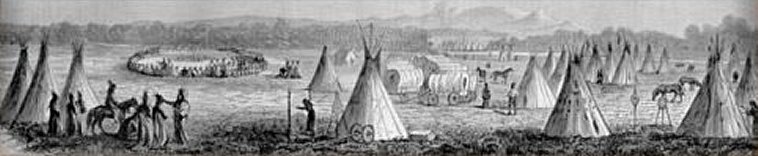
Indian Lodge at Medicine Creek, Kansas -- Scene of the Late Indian Peace Council
Harper's Weekly, October 16 - 26, 1867.
Sketch by J. Howland.
Index to articles on this site about the Medicine Lodge Peace Council and Peace Treaties
The Great Flood of April 21, 1885, Barber County, Kansas.
Women's Suffrage, 1887 news articles collected and contributed by Kim Fowles.
The Use and Need of the Life of Carry A. Nation, by Carry A. Nation, Revised edition, 1905.
Roster of the Names of All the Old Cowboys I Knew by T.J. Dyer
Memoirs of Phoebe (Rogers) Gibson:
The Early Days of Barber County, Kansas
Barber County Index, May 16, 1929.Barney O'Conner Tells of Indian Scraps Here:
Early Day Character Relates Incidents From Fund of Pioneer Knowledge
Barber County Index, March 27, 1930.Lee Wynkoop: "Recalls Narrow Escape From Indians"
(Undated newspaper clippings.)Ten Bears, Comanche Chief, Made an Eloquent Address At The Medicine Lodge Peace Council
Barber County Index, September 29, 1927."The Medicine Lodge Peace Council", New York Daily Tribune Report
Barber County Index, September 29, 1927."The Medicine Lodge Peace Council": A Graphic Description of Famous Peace Council By An Eye Witness, Gov. A. A. Taylor of Tenn.
Barber County Index, September 29, 1927.The Medicine Lodge Peace Council Location:
Sworn Statement of I-See-O
Barber County Index, September 29, 1927.29 September 1927
"The Medicine Lodge Peace Council" by George Bent
Barber County Index, September 29, 1927."The Medicine Lodge Peace Council": Some More Interesting Articles Telling About Famous Medicine Lodge Indian Peace Council
Barber County Index, September 29, 1927.EARLY DAYS IN BARBER COUNTY:
Mrs. Jennie Osborn Writes Most Interesting Article Concerning Experiences In Barber County
Barber County Index, September 29, 1927.The West That Was - Cody
Barber County Index, September 29, 1927.Green Adams Describe Things As He Saw Them In Barber County In The Early 1870's
Barber County Index, October 6, 1927.Green Adams: An Early Day Vigilante Committee
Barber County Index, October 13, 1927.Governor Paulen's Address Regarding the Medicine Lodge Peace Council
Barber County Index, October 20, 1927.Tales From The Crypt,
by David Fasgold, The Gyp Hills Premiere, 27 Feb 2006.The Tornado of May 7, 1927, As Told by Florence Mills Wells, interview courtesy of Peggy Wilson Newsome.
Blizzards in Barber County and Comanche County, Kansas
National Gypsum Plant near Sun City, Kansas
Cat Wagons at Sun City, Kansas
National Register of Historical Places: Barber County, Kansas
Medicine Lodge Peace Treaty Site and Carry A. Nation Home/MuseumBarber County History
from William G. Cutler's History of the State of Kansas, published by A. T. Andreas, Chicago, Illinois, 1883.
Copyright © 1996 - The USGenWeb® Project, KSGenWeb, Barber County

This page was last updated
01/28/2026